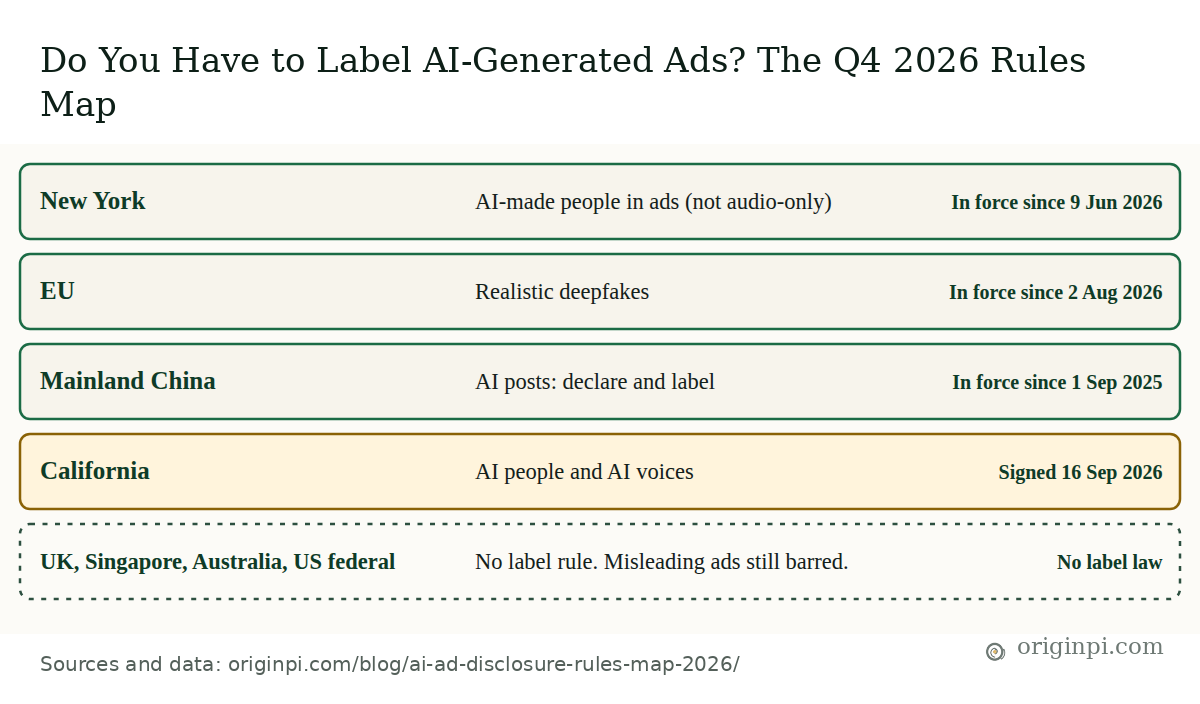
You have to label AI in your own ads only in a few places, and each law means something different by "AI". New York has required a conspicuous label on AI-generated people in ads since 9 June 2026. California signed a version on 16 September 2026 that also covers AI voices. The EU has required a visible label on deepfakes since 2 August 2026. Origin Pi found no general labelling rule in the UK, Singapore, Australia or US federal law, but misleading-ad law applies everywhere and platforms set their own label rules. It is for marketing and compliance leads running one campaign in several markets.
Update, 28 October 2026: We re-checked the TikTok, Google and Meta ad policies, the EU Code of Practice page and New York's GBL 396-b text. None has changed, and California's SB 1050 start date is still our reading rather than a confirmed date; the rest of the map stands as of 17 October.
Rules as of 17 October 2026. New: on 16 September 2026 the governor signed SB 1050, so two large US states now each have a synthetic-performer law.
How we checked: Origin Pi read official texts or regulator pages for the 10 matrix markets in October 2026. Out of scope: other US states, political-ad and sector rules. India is covered by one note below.
At a glance: who must label an AI ad
Duties on the advertiser. Rules as of 17 October 2026.
Which ads need an AI label, market by market?
Three AI-label duties bind advertisers on 17 October 2026: AI-made human performers in New York ads, realistic deepfakes reaching the EU, and AI content posted in mainland China. California signed a fourth on 16 September 2026. Elsewhere, the test is whether leaving the label off would mislead.
This is general information, not legal advice. Ask counsel where a call is close.
Rules map
Who must label what, by market and asset
"Label" means a duty on the advertiser. Rules as of 17 October 2026.
| Market | AI person | AI voice | AI image or video | AI text | Chatbot |
|---|---|---|---|---|---|
| New York | Label since 9 Jun 2026 | Exempt in audio-only ads | No rule | No rule | Not in this law |
| California | Label, signed 16 Sep 2026 | Label, signed 16 Sep 2026 | Tool maker marks | No rule | Not mapped here |
| US federal | FTC Act s5 only | FTC Act s5 only | FTC Act s5 only | FTC Act s5 only | FTC Act s5 only |
| EU | Label if a deepfake | Label if a deepfake | Label if a deepfake | Public-interest text | Provider duty, 50(1) |
| UK | Only if it misleads | Only if it misleads | Only if it misleads | Only if it misleads | Only if it misleads |
| China | Declare and label | Declare and label | Declare and label | Declare and label | Provider labels |
| South Korea | AI operator, Art. 31 | AI operator, Art. 31 | AI operator, Art. 31 | AI operator, Art. 31 | Advance notice, 31(1) |
| Malaysia | Platform labels | Platform labels | Platform labels | Not in the code | Not in the code |
| Singapore | Only if it misleads | Only if it misleads | Only if it misleads | Only if it misleads | Guidance (IMDA) |
| Australia | Only if it misleads | Only if it misleads | Only if it misleads | Only if it misleads | Guidance only |
Key: advertiser must label · depends on context, or sits with the tool maker, platform or misleading-ad law · no rule found · not mapped
Sources: New York GBL 396-b (state law); California SB 1050 and the AI Transparency Act (governor and Assembly pages); FTC Act s5; EU AI Act Art. 50; CAP Code 3.1; China Labelling Measures Art. 10; Korea AI Basic Act Art. 31 (KLRI English text, not legally binding); Malaysia MCMC Code 4.2.4(d); Singapore CPFTA s4; Australian Consumer Law s18. China: Origin Pi's translation. Not legal advice.
Three rows need a word. China's labelling measures (our translation), in force since 1 September 2025, tell users who publish AI content to declare it and use the platform's label tool (Article 10); the regulator acted against two apps and a website on 28 April 2026. South Korea's AI Basic Act, in force since 22 January 2026, puts the label on the AI business operator (Article 31), with no fines for at least a year per the science ministry. Malaysia's online safety code, enforced since 1 June 2026, makes licensed platforms label realistic AI media. India sits outside the matrix. The Ministry of Electronics and IT says in a PIB release of 6 August 2026 that on 10 February 2026 the government amended the IT Rules 2021 so that intermediaries must label AI-generated content and attach traceable metadata. Check MeitY's notification for what applies to your ads.
US scope: Origin Pi found no federal statute requiring AI labels on ads as of 17 October 2026 (pending bills are not law). Federally, section 5 of the FTC Act bars unfair or deceptive practices, enforced through FTC orders (see the Active Listening case below). New York 396-b and California SB 1050 are state law. Political-ad and sector rules are out of scope.
Timeline
When each rule bites, 2026 to 2027
Eight dates that change what a campaign must carry.
22 Jan 2026
Korea AI Act in force
AI operators must label generative output (Art. 31). Fines wait at least one year, per the science ministry.
1 Jun 2026
Malaysia code enforced
Licensed platforms must label realistic AI media and let advertisers declare it.
9 Jun 2026
New York law in force
Ads with an AI-made human performer must say so conspicuously.
2 Aug 2026
EU Art. 50 applies
Deployers label deepfakes; tool makers mark output. California's AI Transparency Act (a tool-maker duty) also became operative.
27 Aug 2026
FTC Active Listening orders
Three firms settle with the FTC over a false AI ad-targeting claim. A claims case, not a labelling case.
16 Sep 2026
California bill signed
SB 1050: video or audio ads using AI-generated performers need explicit disclosure.
2 Dec 2026
EU marking grace ends
Tools on sale before August must mark their output by this date. Your label duty did not wait.
1 Jan 2027
California start
Our reading: California statutes usually take effect on 1 January after enactment, so we expect it to apply from 1 January 2027; check the chaptered bill.
What do New York and California require for AI people in ads?
New York and California both require a clear disclosure when an ad features an AI-generated human performer who is not a recognisable real person. New York's General Business Law 396-b has applied since 9 June 2026. California's SB 1050, signed on 16 September 2026, adds AI voices: the governor's release says it requires explicit disclosure on any video or audio advertisement that uses AI-generated performers. Our reading: California statutes usually take effect on 1 January after enactment, so we expect it to apply from 1 January 2027; check the chaptered bill.
New York's law covers AI-made human performers who are not recognisable real people, and the advertiser must disclose where it has "actual knowledge". The enacted bill text sets a civil penalty for each violation, higher after the first.
"shall conspicuously disclose in such advertisement that a synthetic performer is in such advertisement"
New York General Business Law 396-b(3), nysenate.gov, law signed 11 December 2025, applying from 9 June 2026.
| Question | New York (GBL 396-b) | California (SB 1050) |
|---|---|---|
| Applies from | 9 June 2026 | Signed 16 Sep 2026; starts 1 Jan 2027 |
| What counts | AI human, visual or audiovisual | AI figure, voice or representation |
| Audio-only ads | Exempt | Covered |
| Real, recognisable person | Not covered | Not covered |
| Translation only | Exempt | Exempt, plus accessibility |
| Film, TV, game promos | Exempt if used as in the work | Exempt if used as in the work |
| Penalty | Civil penalty per violation, higher after the first | Enforced as false advertising through the unfair competition law; a court can order media to pull the ad |
California is narrower in one way and wider in another. It bites only when the synthetic performer appears "prominently". Per the Assembly committee analysis (June 2026, pre-final), its definition covers a human-like digital figure, voice or representation, so an AI voice counts. Suggested wording: "this performance features a synthetic digital performer".
The analysis says a breach is a violation of California's false-advertising law, enforceable under the unfair competition law, and that media must pull an ad a court has found in breach. The analysis states no criminal or per-violation civil penalty for SB 1050, so this post states none.
A separate California law sits on the other side of the ad. The AI Transparency Act became operative on 2 August 2026 ("Beginning August 2, 2026", per the Assembly committee analysis) and makes generative AI providers embed hidden provenance data in images, video and audio: a tool-maker duty. The Attorney General, a city attorney or a county counsel can seek a civil penalty per violation, and each day in breach counts as a separate violation.
Penalty structure
All three US laws are enforced civilly, but count a breach differently
How many of the three US laws here use each feature: New York 396-b, California SB 1050, California AI Transparency Act.
All 3 laws are enforced civilly; 2 count a penalty per violation; 1 raises it after the first; 1 counts each day; 1 lets a court order the ad pulled.
| Feature | Laws |
|---|---|
| Civil enforcement | 3 |
| Counted per violation | 2 |
| Higher after the first violation | 1 |
| Counted per day | 1 |
| Court order to pull the ad | 1 |
Illustrative example: a skincare brand runs one video in New York, California and Texas, with an AI presenter who resembles no real person and an AI voice. New York needs a conspicuous disclosure today. California will too from 1 January 2027, when SB 1050 starts, including on a radio cut, which New York exempts. Origin Pi found no Texas statute, so platform rules decide there.
How does the EU rule differ, and who carries it?
The EU splits the job between two parties. Article 50(2) of the AI Act makes the tool provider mark its output "in a machine-readable format". Article 50(4) makes the deployer (the publisher) disclose deepfakes, and has applied since 2 August 2026. For systems placed on the market before then, the Digital Omnibus (Regulation (EU) 2026/1744) gives providers until 2 December 2026 for Article 50(2); new systems have no grace.
Breaches can be fined up to 3% of worldwide turnover or a fixed cap, whichever is higher, and whichever is lower for SMEs.
A deepfake under Article 3(60) is content that "resembles existing persons, objects, places, entities or events and would falsely appear to a person to be authentic or truthful", so a misleading AI product shot counts. The Commission's Article 50 guidelines of July 2026 (paragraph 116) treat aesthetic background replacement as likely minor, but an image that makes the product look better than it is as a deepfake, case by case. See our guide to the 2 December deadline.
The Commission's Code of Practice on marking and labelling (10 June 2026) is voluntary: signatory tool makers commit to signed metadata plus an imperceptible watermark, and signatory deployers to an "AI" icon or equivalent label.
Who owes the label: four roles, four kinds of duty
Selected rules that touch an AI ad, by who carries them. Rules as of 17 October 2026.
What do Meta, Google, TikTok and YouTube require?
TikTok has the strictest platform rule. Its ads policy, last updated April 2026, says "If we identify AI-generated content that has not been disclosed, your ad will be rejected or restricted." These are policies, not law.
What each platform asks of an advertiser running AI creative:
| Platform | What triggers a label | Who applies it |
|---|---|---|
| TikTok ads | Fully AI or significantly AI-edited media | You: AIGC label or own disclaimer |
| Meta | Political or social-issue ads with realistic altered media | You must self-disclose |
| Meta, other ads | Ads made with Meta AI tools; third-party AI detection rolling out | Meta adds "AI info" |
| Google Ads | AI-made or edited assets you flag | You flag the assets |
| Google election ads | Synthetic or altered content | You tick the checkbox |
| YouTube (creator uploads) | Realistic AI content | Creator discloses |
Google's July 2026 change is not a new global mandate. Its policy change-log of 9 July 2026 says Google now "permits" AI labels inside ad creatives and that the setting "doesn't guarantee compliance". Meta's 1 June 2026 update says it will "begin automatically detecting ads created or edited using third-party AI tools", so an unlabelled AI ad may get a label anyway.
Is a label enough? What the FTC's Active Listening orders show
A label is unlikely to rescue an ad that misleads. The US Federal Trade Commission's August 2026 orders concerned a false claim about AI, not a missing label, and the UK and Singapore watchdogs agree.
The FTC announced final orders on 27 August 2026 against Cox Media Group, MindSift and 1010 Digital Works. They sold an "Active Listening" service said to use "a special algorithm to listen in on and detect pertinent conversations from smart devices". The FTC says it was not based on voice data. This is AI-washing: overstating what AI does.
The FTC acted under the FTC Act, which bars deceptive practices. The lesson holds for any AI claim: say only what the product does.
The UK's advertising regulator has no AI disclosure rule and sees no cure in one: its May 2025 guidance says "There is no blanket legal requirement in the UK to disclose the use of AI in ads". Singapore's ASAS, in its 23 March 2026 release, called "indiscriminate and vague disclosures of AI usage" unhelpful, and the ministry's 5 August 2026 written answer said it will "assess if they should be mandated". See also who is liable for AI ad claims.
"disclosure alone is very unlikely to mitigate the harm caused by a fundamentally misleading message"
UK ASA and CAP, guidance on disclosing AI in advertising, 29 May 2025.
How do you check a campaign before it ships?
A campaign team can clear AI labelling with three checks per asset: what the AI made, where the ad runs, and what the ad claims. Run the decision tool once per market.
Decision tool
Does this ad need an AI label?
A guide, not legal advice. Nothing you enter leaves your browser.
- Check: New York GBL 396-b may apply: an AI performer who is not a real person, not audio-only or a film or game promo.
- Check: New York GBL 396-b(7) may exempt the ad: audio-only or translation-only use.
- Check: an exemption may apply: promos for films, shows or games using the performer as in the work.
- Check: California SB 1050 may apply from 1 January 2027: a prominent AI figure or voice.
- Check: consent and publicity-rights law may apply: a real person or digital twin.
- Check: platform rules may apply: no AI performer in New York or California.
- Check: EU AI Act Article 50(4) may apply: a realistic AI image, audio or video that is not evidently artistic.
- Check: Article 50(4) may allow a light-touch disclosure: evidently artistic or fictional work.
- Check: Article 50 may not be triggered: stylised content, or AI scenery behind a real product shown as it is.
- Check: China Labelling Measures Art. 10 may apply: declare and label AI content.
- Check: platform rules and misleading-ad law may apply: UK, Singapore, Australia, US federal.
Test yourself on three cases campaign teams meet.
Three cases
Label, exempt, or a different problem?
Pick an answer to see the rule behind it. Rules as of 17 October 2026.
Cases are illustrative. Not legal advice. Nothing you enter leaves your browser.
Our free AI compliance starter pack has the asset log and approval templates.
Where Origin Pi stands
We think most teams over-label the wrong assets and under-check the right ones. The bigger exposure is a realistic AI image or claim that misleads, which a label is unlikely to cure.
We design AI compliance workflows that record which tool made each asset, whether it shows a person or a voice, and which markets it targets, and hold risky assets until a named person approves. For marketing teams shipping AI creative at volume, that is cheaper than relabelling after launch.
Your first step this week: list every AI-made person and voice in the creative running in New York now, and check each against the decision tool.
Take the data with you
Every figure here is in one table with sources; the card is shareable. Please cite this post if you reuse either file.
Next step
Put the label decision into your workflow
Origin Pi
AI-content compliance pack
We map your markets and asset types to the rules above, and design the asset log, label step and approval trail for your content pipeline.
Ask for an AI-label reviewleapbuzz
Compliant AI creative for paid social
Plan and run paid-social campaigns with AI creative, labels set per market and platform, with Origin Pi's marketing consultancy brand leapbuzz.
See paid-social services