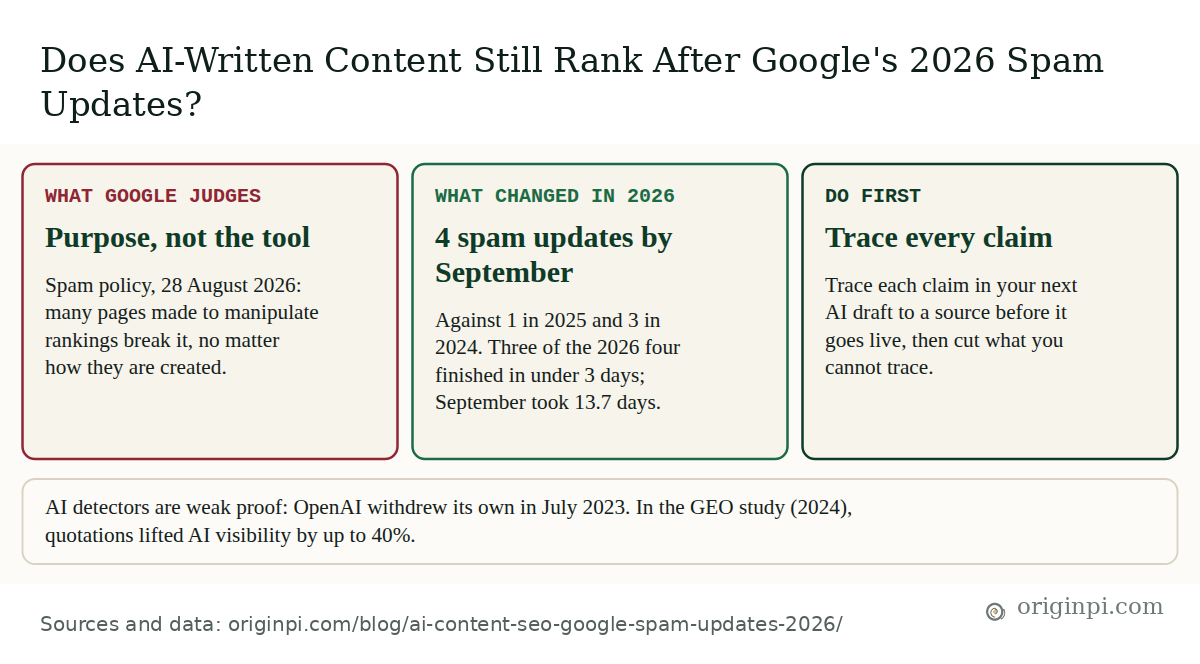
AI-written content can still rank on Google and get cited by AI answers, because Google judges why a page exists and what it adds, not which tool typed it. What Google penalises is scaled content abuse: many pages made to game rankings that give readers little. In 2026 Google ran four spam updates by September, against one in 2025. For marketing leads and owners publishing with AI, the safe answer is a governed workflow: sourced briefs, a claim-by-claim fact-check and a named human who signs off.
Update, 28 October 2026: We re-checked Google's spam-policy, generative-AI and helpful-content pages and the Search Status Dashboard: the page dates are unchanged and no new ranking update has been listed. The DeGenTWeb study was revised on 26 October, so we replaced its figures with version 2's, for example 13.6% of Bing-linked sites AI-dominant, down from 15.4%.
Google's Search Status Dashboard logged the September 2026 spam update on 24 September and records that the rollout was complete as of 8 October 2026, after 13 days and 16 hours. That is more than four times as long as any other 2026 spam update.
At a glance: AI content and Google in 2026
Three findings and one first step, each sourced below.
Does Google penalise AI-written content?
Google does not penalise content for being AI-written. Its spam policies (updated 28 August 2026) define scaled content abuse as "many pages" made "for the primary purpose of manipulating search rankings and not helping users", and add "no matter how it's created". Generative AI is named as one route into that policy, not as the offence. The first example on the list reads:
Using generative AI tools or other similar tools to generate many pages without adding value for users
Google Search Central, Spam policies for Google web search, last updated 28 August 2026.
The offence in that line is "many pages" and "without adding value", not the tool.
Google's guidance on using generative AI content, last updated on 1 October 2026, is blunter about the real risk. "Generative models don't retrieve facts, but predict a likely sequence of words," it says, so "It is critical to manually factcheck and review all AI-generated content for accuracy and trustworthiness before publishing." That review covers titles, meta descriptions, structured data and image alt text too.
Google's spam policy page defines scaled content abuse as "many pages" generated "for the primary purpose of manipulating search rankings and not helping users", typically "large amounts of unoriginal content that provides little to no value to users". The fact-check duty comes from the accuracy and trustworthiness guidance quoted above, which is a separate point.
Myth or fact
Six things teams believe about AI content and Google
Decide first, then reveal what Google's own documents say.
Google detects AI writing and pushes it down.
Myth
Google's February 2023 guidance: "Using AI doesn't give content any special gains. It's just content." Its spam policy applies "no matter how it's created". The test is purpose and value.
Lots of AI pages are fine if each one is unique.
Myth
Unique is not the bar. Google's first example of scaled content abuse is "Using generative AI tools or other similar tools to generate many pages without adding value for users" (spam policies, 28 August 2026).
A good model makes fact-checking optional.
Myth
Google: "It is critical to manually factcheck and review all AI-generated content for accuracy and trustworthiness before publishing", including titles, meta descriptions, structured data and alt text (1 October 2026).
You must label every AI-assisted page for Google.
Partly
For web pages, disclosures are useful "where someone might think 'How was this created?'" and should be added "when it would be reasonably expected". Merchant Center does require labels on AI product titles and descriptions.
Hiding the AI role is fine if the facts are right.
Partly
Google's generative AI guidance says "Sharing information about how a piece of content was created can help give your readers more context." Inventing a human author is worse. The helpful-content page lists "Fabricating creator profiles" as a warning sign and says "Any form of deception makes a page untrustworthy to both users and our automated quality systems".
Updating the date makes a page look fresh to Google.
Myth
Google lists "changing the date of pages to make them seem fresh when the content has not substantially changed" as a warning sign. Refresh the facts, then the date.
Quotes from Google Search Central pages as they stood on 21 October 2026: spam policies (updated 28 August 2026), generative AI guidance (updated 1 October 2026), helpful-content guidance (updated 5 October 2026), and the February 2023 AI content post.
What did Google's 2024 to 2026 updates change?
Google's Search Status Dashboard lists 17 core and spam updates from March 2024 to September 2026. Spam updates sped up in 2026: four by September (March, June, August and September), against one in 2025 and three in 2024. The March, June and August 2026 updates each took under three days. September's took 13 days and 16 hours, and the August 2025 one took 26 days and 15 hours. Scaled content abuse itself has been a named policy since Google's 5 March 2024 announcement.
A core update is, in Google's words on its core updates page, a broad change that does not "target specific sites or individual web pages". A spam update improves SpamBrain, Google's AI-based spam-prevention system, and Google says sites that break its policies "may rank lower in results or not appear in results at all". Recovery is slow; the spam updates page says changes may help once its systems "learn over a period of months" that a site complies.
Google ranking updates, 2024 to 2026
Three of four 2026 spam updates finished in under three days
Rollout length in days, by update, as Google's dashboard records it. Switch between spam and core updates.
Spam updates took 7.0 to 26.6 days in 2024 and 2025. In 2026 the March, June and August updates took 0.8, 2.0 and 2.7 days, and the September update took 13.7 days. Core updates ran 6.2 to 45 days.
| Update (start) | Days |
|---|---|
| Mar 2024 | 14 d 21 h |
| Jun 2024 | 7 d 1 h |
| Dec 2024 | 7 d 2 h |
| Aug 2025 | 26 d 15 h |
| Mar 2026 | 19 h 30 min |
| Jun 2026 | 2 d 1 h |
| Aug 2026 | 2 d 16 h |
| Sep 2026 | 13 d 16 h |
| Update (start) | Days |
|---|---|
| Mar 2024 | 45 d |
| Aug 2024 | 19 d 4 h |
| Nov 2024 | 23 d 13 h |
| Dec 2024 | 6 d 4 h |
| Mar 2025 | 13 d 21 h |
| Jun 2025 | 16 d 18 h |
| Dec 2025 | 18 d 2 h |
| Mar 2026 | 12 d 4 h |
| May 2026 | 11 d 21 h |
Updates per year
2026 has already matched 2024 and 2025 combined for spam updates
Number of core and spam updates Google listed each year. 2026 runs to 21 October.
Core updates: 4 in 2024, 3 in 2025, 2 in 2026 so far. Spam updates: 3 in 2024, 1 in 2025, 4 in 2026 so far.
| Year | Core | Spam |
|---|---|---|
| 2024 | 4 | 3 |
| 2025 | 3 | 1 |
| 2026 to 21 Oct | 2 | 4 |
None of the dashboard entries says what an update targeted. Claims that the August or September 2026 updates "hit AI content" are guesses. Our reading: Google now runs its spam systems more often, so a page made to game rankings may have less time before it gets caught.
How much of what ranks is already AI-written?
Nobody can say exactly. Three 2026 studies, all arXiv preprints not yet peer-reviewed, give figures from 7% of websites to 44% of searches, depending on whether they count sites, new sites, text or search results. Every one of them relies on an AI detector, so each inherits the detector's error.
At its January 2023 launch, OpenAI's own classifier caught 26% of AI-written text and wrongly flagged 9% of human text (Decrypt, 24 July 2023). OpenAI later added a note to that page. Search Engine Journal (25 July 2023) quotes it: "As of July 20, 2023, the AI classifier is no longer available due to its low rate of accuracy." The DeGenTWeb study scores whole sites at a low false-positive setting; the other two rely on one commercial detector, Pangram.
Share of AI content, by what is counted
From 7% to 44%: the answer depends on what you count
Six measurements from three 2026 arXiv preprints (not yet peer-reviewed). Each bar counts a different thing; read the label.
43.8% of the ten thousand Bing how-to searches sampled showed at least one AI-dominant site in the top 10, while only 7.3% of sampled Common Crawl sites were AI-dominant. Newer sites and recent web text score far higher than the web as a whole.
| What was counted | Share |
|---|---|
| Bing searches, AI-dominant site in top 10 | 43.8% |
| New websites, AI-made or AI-assisted, mid-2025 | 35% |
| Web text tokens labelled AI, Aug 2026 | 31.1% |
| Sites first archived H1 2025, AI-dominant | 25.0% |
| Sites in Bing how-to results, AI-dominant | 13.6% |
| All sampled web sites, AI-dominant | 7.3% |
Here is what each study measured.
| Study (detector) | What it counted | Result |
|---|---|---|
| DeGenTWeb v2, USC, first posted April 2026 (Binoculars, open source) | Sites in Bing's top 20 for 10,000 how-to queries | 13.6% of sites AI-dominant |
| DeGenTWeb v2, USC, first posted April 2026 (Binoculars) | 117,069 Common Crawl sites | 7.3% overall; 25.0% of sites first seen in H1 2025 |
| Dolezal et al., April 2026 (Pangram v3, supplied under a research grant) | New websites sampled from the Internet Archive | Roughly 35% by mid-2025 |
| Russell et al., September 2026 (Pangram, whose staff co-wrote the paper) | Tokens (word pieces) in Common Crawl text after FineWeb quality filtering | 31.1% in August 2026 |
The most useful finding for marketers is a ranking one. The DeGenTWeb study (He, Ardi, Govindan and Madhyastha, version 2) found Bing "does not seem to significantly down-rank" AI-dominant sites: their median rank was 12, against 11 for the rest. The study did not measure Google. In that Bing sample AI-dominant sites were not buried, and a ranking today proves nothing about the next spam update. The Internet Archive study found no statistically significant evidence that more AI text had made the web less accurate, though it did link it to lower semantic diversity. The Russell et al. preprint, by authors from the University of Maryland and Pangram Labs, measured the share of web text, not pages.
What gets a page cited in AI answers?
Pages get cited when they carry checkable substance. In the GEO study (Aggarwal, Murahari, Rajpurohit, Kalyan, Narasimhan and Deshpande, KDD 2024), which built a benchmark of 10,000 queries and tested edits against an AI answer engine, the best methods raised a source's visibility by up to 40%. In its Table 1, adding quotations scored 27.2 against 19.3 for the unedited page. Statistics and cited sources followed. Keyword stuffing scored below doing nothing.
What lifts AI citation
Quotes, statistics and sources won; keyword stuffing lost
Visibility score in AI answers after one edit to a source page (position-adjusted word count; higher means more of the answer drew on that page). The dashed line is the unedited page.
Adding quotations scored 27.2, statistics 25.2, fluency 24.7 and cited sources 24.6, against 19.3 for the unedited page. Keyword stuffing scored 17.7, below the unedited page.
| Edit made to the page | Score |
|---|---|
| Add quotations | 27.2 |
| Add statistics | 25.2 |
| Improve fluency | 24.7 |
| Cite sources | 24.6 |
| Add technical terms | 22.7 |
| Make it easier to read | 22.0 |
| Sound authoritative | 21.3 |
| Add unique words | 20.5 |
| Stuff keywords | 17.7 |
Two caveats. The paper used GPT-3.5 answering from the top five Google results, and in its Perplexity.ai test the best gain was smaller (quotations plus 22%). Still, the direction matches Google's quality guidance: a quote, a number or a source only helps if it is real, which is why the fact-check stage matters for citation as much as for ranking.
The survey data suggest speed gains are outrunning results. In the Content Marketing Institute and MarketingProfs survey of 1,015 B2B marketers (B2B Content and Marketing Trends: Insights for 2026, published 8 October 2025), 95% said their organisations use AI tools.
What marketers say AI changed
AI made content faster far more often than it made content perform
Share of B2B marketers using AI for content creation who say each area improved. Self-reported.
87% say productivity improved and 80% say efficiency improved, but only 58% say quality improved and 39% say content performance improved; 12% say quality got worse.
| Area | Improved |
|---|---|
| Productivity | 87% |
| Operational efficiency | 80% |
| Creative capabilities | 65% |
| Content quality | 58% |
| Content performance | 39% |
What does a governed AI content workflow look like?
A governed AI content workflow lets AI draft while people own the facts and the sign-off. It has seven stages: brief, sources, draft, fact-check, expert edit, publish and refresh. The fact-check is a hard gate: any claim without a traceable source stops the draft. This is a method for meeting Google's stated bar, not a promise of rankings.
Each stage has one owner, one way it fails and one control. The times are illustrative, for a 1,500-word post.
Brief and sources: about 30 minutes, editor
The editor writes the reader's question and the decision the page should help with, then builds a source pack of primary pages: official documents, papers, filings. Fails when the brief is a keyword list and the model fills gaps from memory. Control: no draft starts without a source pack.
Draft: about 15 minutes, AI under the editor's rules
The model drafts only from the pack and marks every claim with the source it used. Fails when the model adds a plausible number, quote or date nobody gave it. Control: any fact without a source tag is treated as a defect, not a style issue.
Fact-check: about 60 minutes, AI lists, a person checks
A second pass lists every checkable claim; a person opens each source and confirms the exact wording, number and date. Fails when the checker trusts the model's citation without opening it. Control: a claim that cannot be traced is cut or rewritten as opinion.
Expert edit: about 75 minutes, a specialist
Someone who knows the subject adds what the sources alone do not: the decision rule, the trade-off, the worked example. Fails when the edit is a proofread. Control: the editor asks what this page says that the top five results do not.
Publish: about 15 minutes, a named approver
A named person signs off the page, its title, meta description, structured data and image alt text, which Google says need the same review. Fails when nobody owns the metadata. Control: the approver's name and date go in the log.
Refresh: on a set date, the editor
Every dated fact gets a review date. When it arrives, the page goes back to the fact-check stage, and the date changes only if the content does. Fails when a stale number stays live. Control: a calendar of review dates, not a habit.
Here is a prompt for the first pass of the fact-check stage. It lists claims; a person still opens every source.
Try this prompt
First-pass fact-check for an AI draft
Fill in your details, copy, then paste your draft at the end. The model lists claims; it does not verify them.
You are a fact-checker for a business blog in [MARKET]. The reader is [AUDIENCE]. The page will be published on [PUBLISH_DATE].
Do not rewrite the draft below and do not add any facts.
1. List every checkable claim: each number, percentage, date, name, quote, ranking, price, legal or policy statement, and any cause-and-effect claim.
2. For each claim give the exact sentence, the claim type, the source the draft names (write NONE if there is none), and the kind of primary source that would prove it, such as an official page, a law, a peer-reviewed paper or a company filing.
3. Flag any claim that has no date, that could have changed before the publish date, or that cites a study without saying who ran it and how.
4. Flag any quote that may not be word for word, and any number that looks rounded differently from its source.
5. Give each claim a verdict: KEEP (primary source named), CHECK (source missing or second-hand) or CUT (no source likely exists).
Return a table with the columns: number, claim, type, named source, source needed, flag, verdict. List the CHECK and CUT rows first.
DRAFT:
Check the checker before you trust the table
- Every number in the draft appears in the table.
- No claim is marked KEEP without a named primary source.
- The model added no facts of its own.
- A person opens every CHECK source before the page goes live.
A first pass, not a verdict. Nothing you type leaves your browser.
Set your own numbers below.
What if
What does a checked AI post cost against an all-human one?
Governed hours per post = (brief, sources and AI draft minutes + fact-check minutes + expert edit and sign-off minutes) / 60. Cost = hours x hourly rate. All-human cost = writing hours x rate. Model and tool fees are left out.
Illustrative defaults, not measured data: 45 + 60 + 90 minutes = 3.25 hours a post, against 8 hours all-human. At your hourly rate that is 3.25 x rate against 8 x rate; with a rate of 80 the outputs read 260 and 640 per post. At 8 posts a month that is 26 hours against 64 hours. Nothing you enter leaves your browser.
Illustrative example: the starting values in the tool are placeholders, not measured data and not a benchmark. Replace them with the minutes from your own pilot: your numbers in, your answer out.
The workflow means something different to each role:
- Marketing lead. Approve claims and angles, not word counts; Google's helpful-content page lists writing to a word count because you have heard Google prefers one as a warning sign.
- CTO or technical lead. Make the gate enforceable: the publishing tool refuses a page with untraced claims, and serves the text in the HTML so crawlers and AI answers can read it.
- Owner or MD. Decide how many pages you can check, then publish that many. Volume beyond your checking capacity is the scaled-abuse pattern.
- Compliance. Keep the log of claim, source and approver. We suggest keeping this record as good practice. Our post on AI-written advertising claims describes a similar record.
Is your page citation-ready?
A citation-ready page answers the question early, names its sources and carries facts a reader can check, which is what lifted visibility by up to 40% in the GEO study. The twelve checks below combine that finding with Google's people-first questions. Score a live page; the gaps list shows what to fix first.
Interactive check
Is this page citation-ready?
Twelve checks for one page. Tick what is true today. A guide, not an audit. Nothing you enter leaves your browser.
0of 12 checks in place
Fix these first
Built from Google's helpful-content (5 October 2026) and generative AI guidance (1 October 2026) and the GEO study (KDD 2024). A guide, not a ranking promise.
Our guide to measuring citation share covers how to tell whether the fixes worked.
Where Origin Pi stands
Google's spam policy targets low-value publishing at scale, whether people or AI made the pages, and in 2026 its spam updates ran more often. Our reading is that teams able to show where every claim came from are better placed for Google's bar and for AI answers that favour quotes, statistics and cited sources. That is not a ranking promise.
We design and build the workflow layer around AI content, not the rankings. That means a source pack the model must draft from, a claim extractor that lists every fact, a confirm step where a named person approves before anything publishes, bounded permissions so the agent cannot publish on its own, and an audit trail that records who approved each claim. It is part of our marketing AI work and connects to the content tools a team already uses through business automation. For the content itself, Origin Pi's marketing consultancy brand leapbuzz runs the editorial side.
Take the data with you
Download every figure in this post as one CSV file with its source and read date, plus the at-a-glance card as a PNG. If you reuse either, please cite this post.
Take the last AI-assisted page you published, list every number, date and quote on it, and open each source. Fix or cut whatever you cannot trace before the next spam update does it for you.
Next step
Put a fact-check gate in your AI content workflow
Origin Pi
AI content ops build
We design the source pack, claim extraction, confirm step and audit log, wired into the tools your team already uses.
Ask about an AI content ops buildleapbuzz
Content that ranks and gets cited
For a content and search audit, editorial and distribution, work with Origin Pi's marketing consultancy brand leapbuzz.
See leapbuzz content services