An AI voice agent selling to Singapore numbers has a human caller's duties: check the register or hold consent, show caller ID, name the sender, keep proof. The duties sit with the sender, and the sender includes whoever pays for or allows the call, not only the vendor whose software dials. DNC below means Do Not Call. General information, not legal advice.
Our post on AI sales outreach covers consent, the 21-day register result and the business-to-business exclusion. This one covers voice: caller ID, the opening line, the chain of senders and recording. Section numbers follow PDPC's Advisory Guidelines on the Do Not Call Provisions (revised 1 February 2021), which cite the Act. Status as at 28 October 2026.
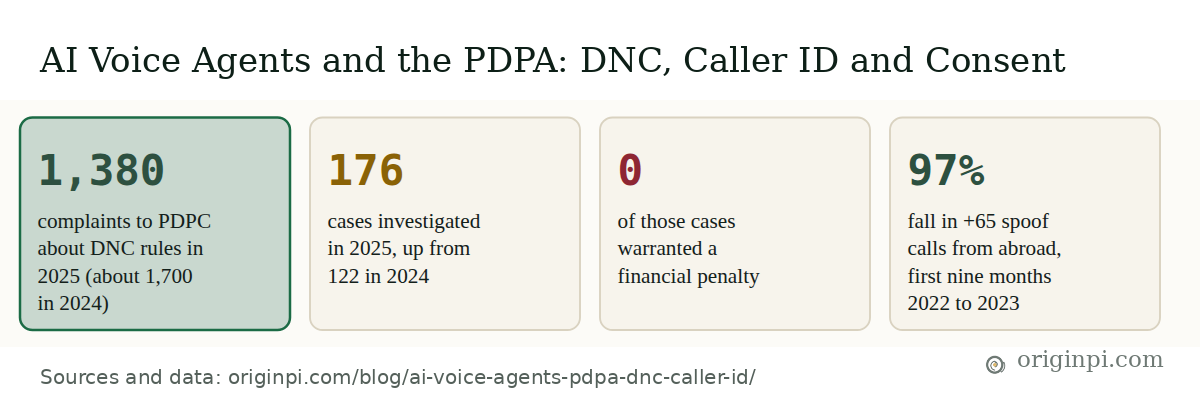
At a glance: what the Singapore record shows on Do Not Call enforcement and spoofed calls
Regulator and IMDA counts. They show activity, not how many AI voice calls break the rules.
Does the PDPA cover an AI voice call, and is anyone enforcing it?
Yes. PDPC's guidelines say the Act's definition of a voice call includes "a call that involves a recorded or synthetic voice". An AI voice agent that rings a Singapore number to promote something is making a voice call, so Parts 9 and 9A of the PDPA, which PDPC calls the DNC Provisions, apply. They cover three registers. The No Voice Call Register covers "voice or video calls sent by a telephone service, data service or any other electronic means". A Singapore number is eight digits starting with 3, 6, 8 or 9.
The check is the same as for any channel: a register result under 21 days old, or clear and unambiguous consent kept in written or other accessible form.
Two things are new for voice. The register is checked per channel, so a person may be on the No Text Message Register and not on the No Voice Call Register. And a voice agent can change its pitch mid-call. A survey that turns into a sales offer is now a promotional call.
The PDPC and IMDA documents cited in this post set no rule that an AI caller must announce that it is an AI. The DNC guidelines require the caller to identify the sender and give contact details, which is a different duty. Our advice, not a rule: say in the first sentence that this is an automated assistant.
Is the regulator acting on these calls?
PDPC is receiving complaints and investigating cases, and in the last two years reported, none of the investigated cases warranted a financial penalty. In a reply to a parliamentary question on 6 March 2026, the Ministry of Digital Development and Information said PDPC "received approximately 1,700 and 1,380 DNC complaints in 2024 and 2025 respectively". It investigated 122 cases in 2024 and 176 in 2025. It says: "None of these cases warranted a financial penalty." The question put to the Ministry refers to "AI-driven calls", and the reply does not answer it.
Interactive chart
Do Not Call complaints fell between 2024 and 2025
Complaints received by PDPC about the DNC provisions. Both figures are approximate.
2024: about 1,700 complaints. 2025: about 1,380.
| Year | Complaints |
|---|---|
| 2024 | 1700 |
| 2025 | 1380 |
Interactive chart
Investigations rose while complaints fell
Cases PDPC investigated for possible breaches of the DNC provisions.
2024: 122 cases investigated. 2025: 176. None warranted a financial penalty.
| Year | Cases |
|---|---|
| 2024 | 122 |
| 2025 | 176 |
We cannot say how many cases involved AI voices, and no penalty is not permission.
What must the call show and say?
What does the caller ID rule require?
The sender must not conceal or withhold the calling line identity. That is how PDPC summarises section 45.
for voice calls, the sender must not conceal or withhold from the recipient the sender’s calling line identity (section 45 of the PDPA).
PDPC, Advisory Guidelines on the Do Not Call Provisions, Part I, revised 1 February 2021.
The guidelines define calling line identity as "the telephone number or information identifying the sender".
In our reading, a voice-agent stack can go wrong here. Misconfigured, a call can arrive as private, which is withholding, or as a number nobody can call back. The guidelines say nothing more specific, so test your own calls from a Singapore phone before launch, and test again after any change of telephony provider.
Spoofing matters too. IMDA's Annex B on anti-scam measures says that since December 2022 telcos have been blocking "spoofed fixed line and mobile numbers i.e., international calls bearing the '+65 3', '+65 6', '+65 8', and '+65 9' prefix". Calls from abroad with a +65 prefix fell 97% between the first nine months of 2022 and 2023.
Interactive chart
Calls from abroad showing a +65 number collapsed after blocking began
International calls with a +65 prefix made to Singapore, first nine months of each year. The 2022 figure is "around" 700 million.
First nine months of 2022: around 700 million calls. First nine months of 2023: 18 million, of which 12 million were assessed as spoofed and blocked.
| Period | Calls (millions) |
|---|---|
| Jan to Sep 2022 | 700 |
| Jan to Sep 2023 | 18 |
IMDA has also said that incoming international calls carry a "+" or "+65" prefix, and that it found blocking all such calls "unfeasible, as there are legitimate international incoming calls that will carry the '+65' prefix" (MCI reply to a parliamentary question, 11 May 2021, on the MDDI site). Our inference, which these sources do not address: if your provider routes a call from overseas, the call may show a "+" prefix or be blocked. Use a provider that places calls from within Singapore, and test calls from a Singapore phone.
What must the opening line say?
The opening must identify the sender and say how to reach them, in details likely to stay valid for 30 days. Section 44 requires "clear and accurate information" identifying the sender, plus how the recipient can "readily contact the sender". The information "must be reasonably likely to be valid for at least 30 days after the message is sent". The contact route must last, so a rotating pool of temporary lines is a risk. Make it a fixed field, not text the model composes.
Interactive chart
Three clocks a voice agent has to run
Time limits in PDPC's DNC guidelines, in days.
A register result stays valid 21 days from receipt. A withdrawal of consent must take effect within 21 days. The contact information in the call must be reasonably likely to stay valid at least 30 days.
| Clock | Days |
|---|---|
| Register result valid | 21 |
| Withdrawal takes effect | 21 |
| Contact details valid | 30 |
| Duty | Section (per PDPC guidance) | What the voice agent needs |
|---|---|---|
| Check the register or hold consent | 43 | A gate that reads result age at dial time |
| Show the calling line identity | 45 | A tested number the person can call back |
| Name the sender, give a contact route | 44 | Fixed script fields good for 30 days |
| Do not authorise unchecked calls | 37(3)-(4) | A written bar and a gate the vendor cannot skip |
The two 21-day clocks differ: one is the age limit on a register result, the other the "prescribed period" for acting on a withdrawal. Send every opt-out to one suppression list that all diallers read.
Who is liable when a vendor's agent makes the call?
PDPC's guidelines say the sender is anyone who makes the call, causes it to be made, or authorises it. They add: "persons who caused or authorised the sending of the message or the making of the call are also senders". In their voice example, Organisation ABC hires Organisation 123 to run its marketing, and 123 engages a call centre to place voice calls. PDPC says ABC, 123 and the call centre are all senders: "ABC and 123 would be considered a 'sender' because they have separately authorised the making of a voice call containing a specified message".
An AI voice platform stands where the call centre stood. If you supply the list and the script, you authorise the call.
There is a defence. Section 37(4) says a person who "takes reasonable steps to stop the sending" is deemed not to have authorised it, and PDPC's example of a reasonable step is "requiring, as a condition of the authorisation given, that Person B shall not promote Person A's goods by sending specified messages addressed to Singapore telephone numbers". Our advice: write the bar, and make the dialler unable to call without a pass from your gate.
Illustrative example: a retailer gives an agency a list and a script, and the agency calls with a voice platform. If it skips the register check, the retailer authorised those calls.
Can you record the call, and is the recording consent?
A voice recording can be personal data, so a recorded call needs notice and consent unless an exception applies. PDPC's selected topics guidelines (revised 23 May 2024) say an audio recording "may comprise personal data if an individual can be identified from that audio recording". Their worked example is a photograph or video, which needs notice and consent "unless an exception under the PDPA applies". Our reading is that audio follows the same logic, so say at the start that the call is recorded, and why.
There is a trap with marketing consent. PDPC's Key Concepts guidelines (revised 29 April 2026) say consent to specified messages "should be evidenced in written or other accessible form" and that "verbal consent alone would be insufficient". The DNC guidelines say possible forms of evidence "include an audio or video recording of the consent given". So a spoken "yes" on an unrecorded call proves little. A recorded one, or a written confirmation sent afterwards, proves more. That recording needs its own notice.
How should the call flow work, and can this call go out?
Put the checks before the dial and the duties inside the call. The diagram shows our design pattern, built from the guidance above.
The call flow of a voice agent: four checks before dialling, four duties on the call
Our design pattern built on PDPC guidance, not a statutory checklist. Any failed check holds the call.
Four checks run before any call and four on the call and after it. The agent proposes and the gate decides. If a check cannot run, the call is held: that "fail closed" rule is our design choice. See the pre-send gate and the audit trail.
Can this call go out?
Answer up to eight questions about one planned call. It is a guide, not legal advice.
Decision tree
Can this AI voice call go out?
A guide, not an audit. Nothing you choose leaves your browser.
- Outside the DNC rules: the call promotes nothing, so the register check does not apply.
- Outside the DNC rules by number: not a Singapore number, so check the rules of the country you are calling.
- Excluded, with care: a call to an organisation for its own purpose, until it turns personal.
- Block the call: no evidenced consent and no register result under 21 days old.
- Fix the caller ID first: the calling line identity must not be withheld. If your provider routes from overseas, calls may show a + prefix or be blocked, so use a provider that places calls from within Singapore.
- Fix the opening first: name the sender and give a contact route likely to last 30 days.
- Call can go out: all checks pass. Log the evidence.
- Call with conditions: a vendor dials with no written bar, so you are a sender whoever dials. Fix the contract.
Is your voice agent set up to pass?
Tick what is true today. Heavier items count more.
Self-assessment
Call-flow compliance check
Eight items on the gate, the call and the contract. A guide, not an audit. Nothing you enter leaves your browser.
- 0 to 39%: Calls at risk. Start with the pre-dial gate and the caller ID test.
- 40 to 74%: Partly covered. Close the unticked items marked heavier first.
- 75% and above: Covered. Re-test after any change to your telephony provider or script.
Weights are Origin Pi judgements about which gaps matter most, not legal scores.
Where Origin Pi stands
We treat voice compliance as a question of who may dial, on whose pass, with what proof. Origin Pi builds governed AI agents for businesses in Singapore, Malaysia and India, with the register gate, the caller-ID test and the opening script as code and an evidence log, so a vendor or a prompt cannot dial around them. A second voice risk, cloned voices used to fake a boss, is in our payment approval rule. For liability beyond calls, see our PDPA liability analysis.
We have not covered Malaysian or Indian voice rules. Check them before you dial there.
Your first step this week: place one test call from your voice agent to a Singapore phone. Write down what the screen showed, what the agent said first, and which check let the call through.
Take the data with you
Every figure in the charts and at-a-glance card is in one table, with its source and the date we read it. If you reuse either file, please cite this post.