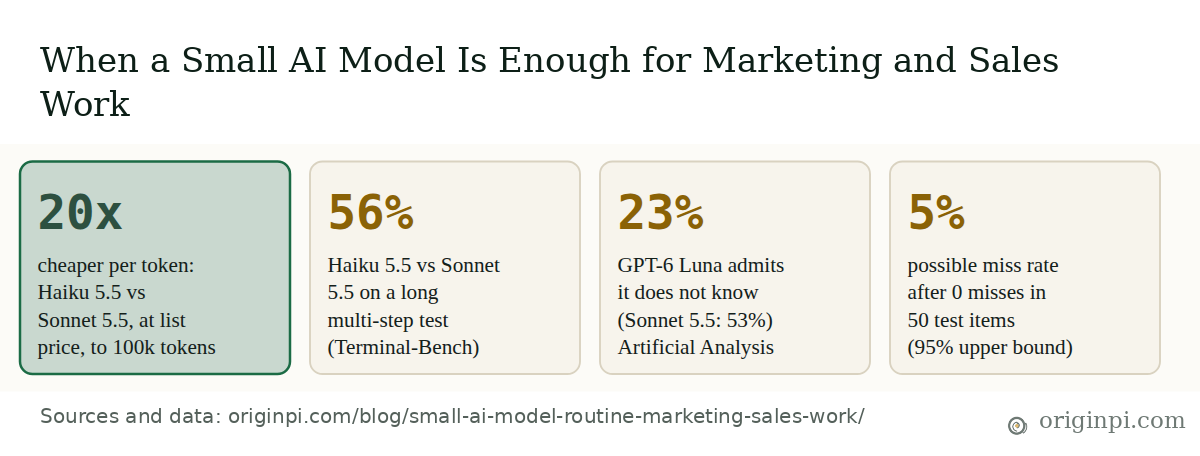
Marketing and sales jobs with a checkable right answer, such as sorting enquiries or pulling fields out of emails, can move to a small AI model. Anything that states a claim should stay with a stronger one. On 7 October 2026 Anthropic launched Claude Haiku 5.5 at about a twentieth of Claude Sonnet 5.5's list price per token on prompts under 100,000 tokens, and OpenAI's GPT-6 Luna sits the same distance below GPT-6 Sol. This guide is for owners and marketing and sales leads who pay a model bill. It shows which jobs can move down a tier, how to test one before you switch, and what to watch once it has.
Our guide to choosing a model for content found that editing time dwarfs token cost for anything a person reads in full. This one covers work nobody reads item by item, where the token bill is the bill.
Update, 28 October 2026: We re-checked the Anthropic, OpenAI and Google price pages and the OpenAI quotes; the ratios and quotes still hold, and Gemini 3.8 Flash's introductory price still doubles at the start of 2027. Artificial Analysis now lists Haiku 5.5, so the line below about it missing from the 4 October snapshot is updated.
At a glance: when a small model is enough
Price and benchmark figures are Anthropic-reported on 7 October 2026; the other two are from Artificial Analysis (4 October 2026) and arithmetic.
What counts as routine work for a small model?
Routine work for a small model is narrow, repetitive and checkable: classify a message, extract fields, summarise a document you supply, tag, route. Anthropic, OpenAI and Google each describe their small tier that way. Their lists overlap closely, and none of them lists open-ended writing.
Anthropic says Claude Haiku 5.5 "reliably handles quick and repetitive workloads (like summaries, compactions, database queries, and classification requests)". OpenAI's model-selection guide points Luna at "fine-grained edits, well-scoped problem-solving, and simple data extraction". Google's pricing page calls Gemini 3.5 Flash-Lite "optimized for high-volume agentic tasks, translation, and simple data processing". OpenAI's changelog adds that on 6 October it put a Luna-based Decisions API into beta for typed answers.
The table maps those lists onto a sales and marketing week. It is Origin Pi's reading, not a benchmark.
| Job | Small tier? | Cheap check |
|---|---|---|
| Sort inbound enquiries by intent and language | Yes: a closed set of answers | Compare with a person's labels on 50 items |
| Pull name, company, product and date out of emails | Yes: the facts are in the text | Allowed values; UNKNOWN when missing |
| Summarise a call or meeting you recorded | Yes, with a sample | A person reads a fixed share; check dated actions |
| Tag reviews, tickets or content by topic | Yes: a closed set again | Compare with labels; watch rare categories |
| Headline, caption and subject-line variants | Try it: low risk | Editing minutes per approved piece |
| Personalised openers at volume | Try it, with a sample | Allow facts only from fields you pass in |
| Copy that states a price, result or guarantee | No: a wrong claim costs more | Mid or top tier, a named approver, a log |
Not sure which row your job is? Answer up to four questions.
Decision tool
Which tier does this job need?
A guide, not an audit. Nothing you choose leaves your browser.
- If the output states a price, a result, a guarantee or a regulated claim, use a stronger model and keep a named person approving.
- If the job is narrow with a checkable answer and you can label about 50 real examples, start on the small tier and test it against one tier up.
- If the job is narrow but you have no labelled examples, build the test first and use the mid tier until you have it.
- If the job is short, low-stakes copy that a person reads before it ships, try the small tier and compare editing minutes.
- If the job is long or open-ended writing, use the mid tier.
How much cheaper is the small tier, and what does it give up?
At Anthropic and OpenAI the small tier costs one-twentieth of the next tier up per token; at Google the gap is far narrower. Claude Haiku 5.5 lists at one-twentieth of Sonnet 5.5, one-fortieth of Opus 5.5 and one-hundredth of Fable 5.1 for prompts up to 100,000 tokens, per Anthropic and its model overview.
GPT-6 Luna lists at one-twentieth of GPT-6 Sol and one-hundredth of GPT-6 Astra, per OpenAI's pricing page. Google's Gemini 3.5 Flash-Lite costs two-fifths of Gemini 3.8 Flash on input and two-thirds on output, per Google's pricing page, and the introductory price of 3.8 Flash will double from 1 January 2027.
Price ratio is not cost ratio. Haiku 5.5 uses a new tokenizer and "slightly more tokens per task", so Anthropic puts its saving against Haiku 4.5 at "around 75%", not the full tenfold list drop.
What does the cheaper model give up? Anthropic published a table on launch day. We divided the Haiku 5.5 and GPT-6 Luna scores by the Sonnet 5.5 score on the four tests where all three appear.
Interactive chart
The gap is small on some tests and wide on long tasks
Score as a share of Claude Sonnet 5.5's score on the same test. Anthropic-reported on 7 October 2026; the shares are our arithmetic.
Haiku 5.5 reaches 56% to 89% of Sonnet 5.5's score; GPT-6 Luna reaches 23% to 81%.
| Test | Claude Haiku 5.5 | GPT-6 Luna |
|---|---|---|
| FrontierCode 1.1 | 89 | 81 |
| OSWorld 2.1 | 86 | 58 |
| Chartography | 75 | 47 |
| Terminal-Bench 4.0 | 56 | 23 |
Read this with care. Anthropic sells Haiku 5.5 and published the comparison, so treat it as a vendor's claim until an independent index covers it. None of the four tests involves marketing copy or sales emails. The chart shows a shape: the gap is moderate on bounded tasks (Haiku 5.5 scored 72.4 to Sonnet 5.5's 83.9 on the OSWorld 2.1 computer-use test, or 86%) and widest on long multi-step ones (39.2 to 70.6 on Terminal-Bench 4.0, or 56%). These are Anthropic-reported scores, and each share compares two scores on one test; it is not a share of tasks done correctly. Anthropic draws the same line.
Sonnet 5.5 and Opus 5.5 remain better choices for complex agentic coding tasks like those measured by Terminal-Bench 4.0. By contrast, Haiku 5.5 is best suited to more narrowly scoped tasks that might otherwise have been cost-prohibitive with previous versions of Claude...
Anthropic, "Introducing Claude Haiku 5.5", 7 October 2026.
Is turning down the effort setting a better saving than switching models?
Often it moves the score as far as switching tier does, so test both settings before you decide. Effort is a dial that tells a model how hard to think. Anthropic says Haiku 5.5 is its "first Haiku-class model to come with an adjustable effort setting".
The Artificial Analysis index gives a sense of the scale. On its 4 October 2026 snapshot, Claude Sonnet 5.5 scored 35.9 at low effort and 56.0 at max effort, with the token price unchanged. GPT-6 Luna at max effort scored 38.1, and Gemini 3.8 Flash at high effort 40.9.
Interactive chart
One model's effort dial spans 20 index points
Artificial Analysis Intelligence Index, snapshot of 4 October 2026. Selected variants only, not the whole index. The index measures reasoning and knowledge work, not copywriting.
Sonnet 5.5 scores 35.9 at low effort and 56.0 at max; GPT-6 Luna at max scores 38.1.
| Model and setting | Index |
|---|---|
| Sonnet 5.5, low effort | 35.9 |
| GPT-6 Luna, max effort | 38.1 |
| Sonnet 5.5, medium effort | 40.8 |
| Gemini 3.8 Flash, high effort | 40.9 |
| Sonnet 5.5, high effort | 46.8 |
| Sonnet 5.5, max effort | 56.0 |
So try two settings: the small tier at middling effort, and the mid tier at low effort. Measure both on your items.
What do cheap models get wrong that a leaderboard hides?
Some small models guess when they should say they do not know, and a single index score hides it. Artificial Analysis runs a test called AA-Omniscience, 6,000 questions across 42 topics. It rewards a correct answer, penalises a wrong guess and leaves "I do not know" neutral. One of its scores is the share of questions a model could not answer where it said so rather than guessing, as defined in the AA-Omniscience paper.
Interactive chart
When a model cannot answer, does it say so?
Artificial Analysis, AA-Omniscience, snapshot of 4 October 2026. Best-index variant of each model. Higher is better for both bars.
GPT-6 Luna admits ignorance 23% of the time, Claude Sonnet 5.5 53%, and the previous Haiku 73%, though that Haiku answers only 18% correctly.
| Model | Says it does not know | Answers correctly |
|---|---|---|
| GPT-6 Luna | 23 | 44 |
| Claude Opus 5.5 | 41 | 66 |
| Gemini 3.8 Flash | 45 | 55 |
| Claude Sonnet 5.5 | 53 | 54 |
| Claude Haiku 4.5 (reasoning) | 73 | 18 |
Price tier does not predict the habit. The previous small Claude model admits ignorance often but knows little. GPT-6 Luna knows a good deal but is the likeliest of the five to fill a gap with a guess. Haiku 5.5 is not in the 4 October snapshot this chart uses. Artificial Analysis now lists it; check its current AA-Omniscience scores before you rely on it for extraction.
Why it matters: an extraction job that invents a company name or a date writes a wrong value into your CRM, and nobody notices until a salesperson quotes it back. Tell the model to write UNKNOWN when the text does not say, and put a few emails with the field missing into your test set.
On writing, OpenAI's model-selection guide assigns "concise writing and content adaptation that preserve facts and nuance" to Astra, its top model, on a low setting, and gives Luna the simple extraction. OpenAI itself does not route copy to its small tier.
How do you route the work and catch the misses?
Send each job through a few fixed rules, check the small model's output cheaply, have a person review a sample, and let anything doubtful move up a tier.
This is a cascade, and the research behind it is older than the current models. The FrugalGPT preprint (9 May 2023) reported that a cascade "can match the performance of the best individual LLM (e.g. GPT-4) with up to 98% cost reduction". RouteLLM (revised 23 February 2025) reported savings "by over 2 times in certain cases" without compromising response quality. Both are preprints on benchmark data: proof of concept, not a forecast for your inbox.
How to route work to a small model, and how to catch its misses
An illustrative loop, not a measured result. The cascade idea comes from the research cited below.
Router rules are plain code: if the text mentions a price, a guarantee or a named person's data, skip the small tier. Automatic checks are cheap tests: the category is on your list, the date parses, no banned phrase appears. The sample check is a person reading a fixed share every week; our post on rubber-stamp review explains why the share must be set in advance. The log records model, version and date, so a later model change is visible.
These routing rules are an operating guide, not legal advice. Regulated claims and personal data follow your market's rules: see our posts on who is liable for AI-generated ads and the PDPA liability gap for AI agents.
How many test items before you switch?
Fifty labelled real examples is a workable start, and zero misses in 50 still leaves a miss rate near 5% as the plausible ceiling. A test cannot prove a model is perfect. It bounds how bad it could be. The calculator below uses a one-sided 95% Wilson upper bound, a standard way to bound a rate from a small sample. It also shows what a cascade costs, with no currency: an all-large-model run is 100, and the small tier is a share of that.
Illustrative example: you label 50 recent enquiries as hot, warm or cold by hand. The small model gets 48 right and misses 2, which is 4% observed, but the bound is near 11%. Is 11% acceptable? If a miss sends a hot lead to the cold pile, probably not, and a person should see every lead the model calls cold. If a miss mislabels a newsletter topic, probably yes. Decide the tolerable rate before the test, not after.
Test and cascade calculator
How bad could the small model be, and what does a cascade cost?
Enter your test result, then how much the small tier costs and how much you escalate. How it works is under the results.
How it works: the miss rate is misses divided by items. The ceiling is the one-sided 95% Wilson upper bound for that rate. Cascade cost = small-tier share + escalated share, in units of one run on the large model, which assumes an escalated task is redone in full and ignores review time. Defaults are illustrative, not measured: the 5% matches a twentieth of the price, and the 20% is a guess you should replace with your own escalation rate. Nothing you enter leaves your browser.
At a twentieth of the price, a cascade that escalates one task in five still costs a quarter of the all-large run. It stops paying only when you escalate nearly everything, a sign the job was never routine.
Where Origin Pi stands
We treat model choice as an operations rule rather than a procurement one. A small tier earns a job by passing a labelled test on your own items, staying inside router rules and being sampled by a person every week.
We build that pattern: routing rules in code, automatic checks, a confirm step before anything that states a price or a promise, and a log of model, version and approver. Our post on agent cost per completed task counts the whole cost of a task, and the automate-or-gate rule for AI SDRs covers the sales side of the same boundary.
Your first step: pick the one routine job that runs most often, label 50 real examples this week, and run them through the small tier and one tier up. If the small tier misses nothing you cannot live with, move that one job and leave the rest.
Take the data with you
Every figure in this post is in one table, with its source, source date and the date we read it. If you reuse either file, please cite this post and link back to it.
Next step
Move the routine work down a tier, safely
Origin Pi
Model routing and content operations
We map your routine jobs to model tiers, write the router and check rules, and build the sample review and the log.
Ask for a model-routing reviewleapbuzz
AI strategy and campaign execution
For campaigns that use the plan, work with Origin Pi's marketing consultancy brand leapbuzz on AI strategy, content and paid media.
See leapbuzz AI strategy