Your staff can paste customer details into an AI tool only when the data and the tool match. Never a personal chat account; only needed fields in a checked business tool; NRIC, bank or health data only with your data protection officer's written approval. This is general information, not legal advice.
At a glance: why your staff need a written AI rule
Can staff paste customer details into ChatGPT?
No for personal accounts. For business tools, only under your written rule: in 2026 Singapore's regulator asked businesses to tell staff which personal data may go in.
Timeline
Official positions on your staff's use of AI tools, 2026
Select a date. The Australian letter applies only to APRA-regulated firms.
30 Apr 2026
Australia: policy alone falls short
APRA review of large banks, insurers and super funds: staff AI use outside approved controls is a concern; many relied mainly on policy.
20 Jul 2026
Singapore: tell staff what may go in
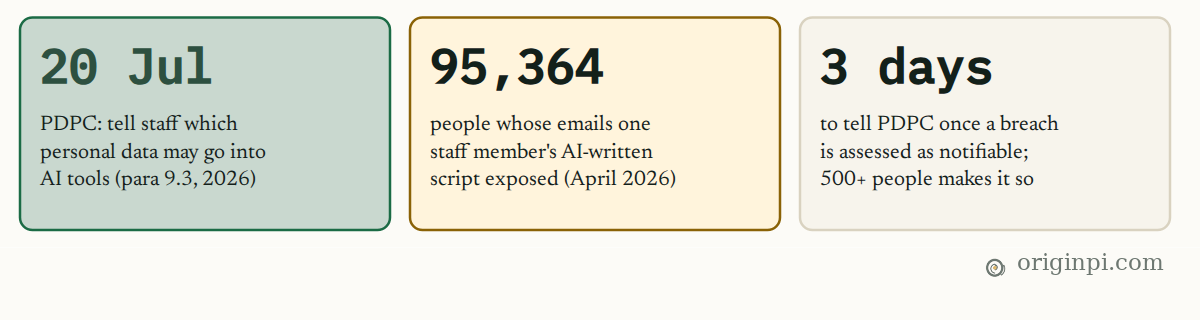
You bear primary responsibility for AI systems you use (paragraph 9.1) and should tell your users which personal data to input (9.3). Advisory; the PDPA binds.
21 Sep 2026
Singapore: no AI policy, 95,364 exposed
Bee Cheng Hiang's undertaking: an AI-written script exposed member emails, and the firm had no staff policy on generative AI.
30 Sep 2026
Singapore: the Shadow AI advisory
On unapproved AI tools used to build scripts: keep an inventory of your AI tools, and tell your staff which data may go in.
This includes educating their end users, whether internal or external, on the specific types of personal data that should be input into their systems (e.g. only pre-defined categories of personal data) and how personal data will be processed following collection.
Personal Data Protection Commission, Advisory Guidelines on Use of Personal Data in Generative AI, paragraph 9.3, issued 20 July 2026.
For the regulator's side, see our PDPC guidelines explainer.
What counts as customer data?
Four classes cover almost everything your staff will paste; when your paste mixes classes, you use the highest.
Four data classes for your staff rule
| Class | What it covers | Examples |
|---|---|---|
| Public | Your business published it; nobody identifiable | Your website prices, brochures, FAQs |
| Internal | Your business information, no person identifiable | Your draft proposal, process notes, sales totals |
| Personal | Anyone identifiable, alone or with your other data | Name, phone, email, order, chat log, photo |
| Regulated | ID numbers, money, health, logins, vulnerable people | NRIC, passport; bank, salary, medical details; logins |
Your Regulated class is stricter than the breach rules on purpose: treat ID, money, health, login and vulnerable-person data as high risk even where a leak might not be notifiable.
Which tool may take which data?
Each paste needs two answers from you: the data class and the tool that receives it.
Traffic-light classifier
Can you paste this into that AI tool?
Your files and screenshots count as pastes. Colours are our rule, built on PDPC sources; PDPC has not graded them. Nothing you enter leaves your browser.
| Data class | Personal or free chat | Checked business plan | In-house, approved for this use |
|---|---|---|---|
| Public | Green | Green | Green |
| Internal | Red | Green | Green |
| Personal | Red | Amber: needed fields only | Green: approved use, needed fields only |
| Regulated | Red | Red, unless the DPO approves in writing | Amber: only if approved for it |
Not sure which tool you have, or nobody has checked your plan contract? Red until someone checks the contract, except for Public data.
Illustrative: to summarise 40 complaint emails, your coordinator pastes only complaint text and order dates into your checked business plan. That is still Personal, so Amber: strip names and phones first.
Where does a pasted customer record go?
Paste into a third-party AI tool and your record goes to the provider's servers, where it is processed, stored and, on some accounts, used for training.
Where a pasted customer record goes
Each step, then your control at that step (green).
What you get back can be code. Bee Cheng Hiang tested an AI-written email script only against activity logs; no customer data went into the AI tool, yet the code exposed emails. Its undertaking with PDPC commits it to independent review of such code (full case).
What does PDPC expect you to write down?
PDPC asks you for six safeguards; your rule covers the staff side, and you still own your tool list and contracts.
What PDPC asks for, and the line in your staff rule that answers it
| PDPC asks for | Where | Your rule line |
|---|---|---|
| Tell your staff which personal data may go in | Guidelines para 9.3 | Your four classes and the traffic light |
| Written AI safeguard policies (encouraged) | Para 9.4; advisory | This one-page rule |
| An inventory of AI tools in use | Advisory, 30 Sep 2026 | Approved tools line, plus a list of tools in use |
| A set purpose for personal data | Para 9.2; PDPA s18 | In-house tools: approved use only |
| Reasonable security for prompts, outputs | Para 9.3; PDPA s24 | No personal accounts; checked plan contract |
| Technical review of AI-written code before it runs | Advisory, 30 Sep 2026 | Code review before any script runs |
In Australia, APRA's 30 April 2026 letter found many large firms relying "primarily on policy direction" rather than "enforceable technical restrictions". Our advice for any firm: pair your rule with a managed business account, and block personal AI accounts on work devices where you can.
Where Origin Pi stands
Fill in three boxes and copy your one-page rule; the colours match the classifier.
One-page staff rule
Customer and staff data in AI tools
Empty boxes keep their [BRACKETS]. First confirm your plan contract rules out training on inputs.
[COMPANY] staff rule: customer and staff data in AI tools
Approved tools: [TOOL] (our business plan, training on our inputs off) and our in-house tools with an owner and a set purpose. Personal chat accounts take PUBLIC data only.
If you are unsure which tool it is, or nobody checked its contract, treat it as a personal account.
Before you paste, pick the class. A mix or a doubt takes the higher class.
Files, screenshots and recordings count as pastes. AI note-takers only if approved and announced.
PUBLIC (we published it, it names nobody): personal account GREEN. [TOOL] GREEN. In-house GREEN.
INTERNAL (our business information, nobody identifiable): personal account RED. [TOOL] GREEN. In-house GREEN.
PERSONAL (anyone identifiable from our records, even masked: name, phone, email, order, chat, photo, voice): personal account RED. [TOOL] AMBER, needed fields only. In-house GREEN, approved use and needed fields only.
REGULATED (ID numbers, bank, card or salary, health or insurance, logins, children or vulnerable people): personal account RED. [TOOL] RED unless [OWNER] approves in writing. In-house AMBER, only if approved for this data.
A second person reads AI-written messages before customers see them. Someone who reads code reviews AI-written scripts before they run.
Pasted something wrong? Tell [OWNER] the same day: tool, time, what you pasted.
Questions: [OWNER], our data protection officer. We review this rule when our AI tools change.
Origin Pi's template, built on the PDPC sources above; PDPC has not approved it, and it is not legal advice. Nothing you type leaves your browser.
Origin Pi's AI governance work sets up the tool list and prompt logs behind this rule; AI compliance maps it to your PDPA duties. If a paste has gone wrong, use our AI incident response plan. For a second reader on your rule, talk to us.
Take the data with you
Cite this post if you reuse the data.