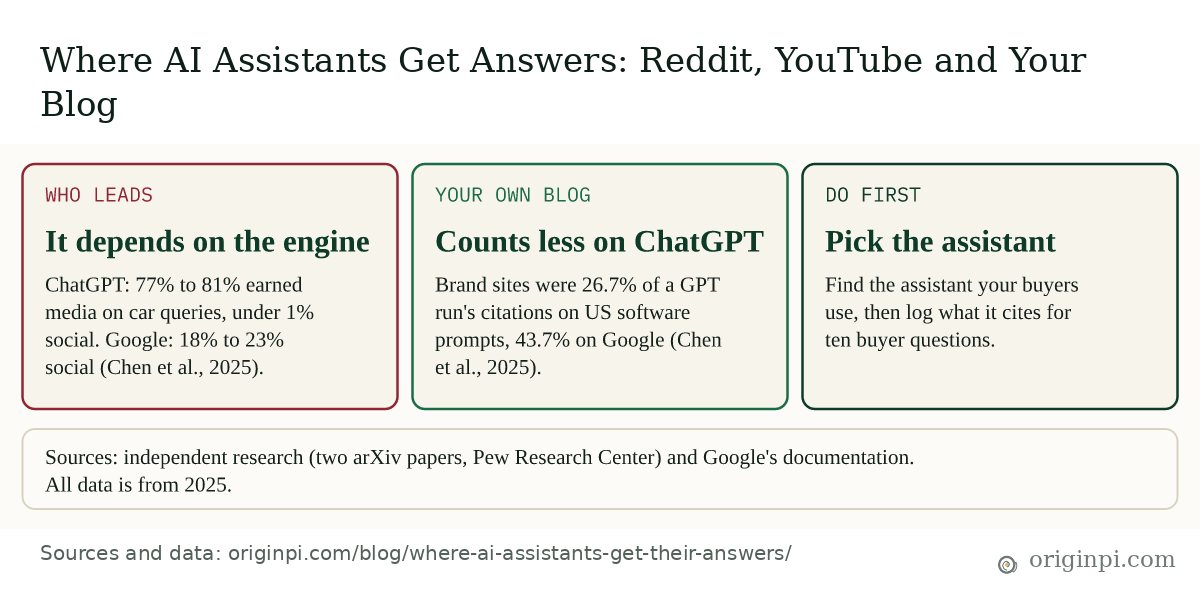
Which sites an AI assistant quotes depends on which assistant you ask, and the sources we found differ on how much. In one 2025 academic test, all four engines drew most brand-question citations from earned sources (independent media and reviews), 63.4% on Gemini to 93.5% on ChatGPT. On car queries, Google drew 18% to 23% of its citations from social sources and ChatGPT under 1%. The studies measure different things, and only that one separates brand pages from independent ones. It is for marketing leads and owners choosing where the next hour goes, and it settles one decision: find your buyers' assistant first.
Everything below comes from academic papers, Pew Research Center and Google's own documentation, which is a vendor's description of its product rather than research. None of it comes from a company that sells SEO or AI-visibility tools. The cost is age: the studies use 2025 data on 2025 models, and the engines have changed since. Fresher vendor trackers exist, and we left them out, so read the figures as directions to test, not current shares.
Update, 28 October 2026: We re-checked the Chen preprint, Pew and Google's AI features page; the figures and quotes are unchanged. The same authors have since posted two follow-ups, arXiv 2601.16858 (January 2026) and arXiv 2610.15033 (10 October 2026), which this post does not use.
At a glance: who the assistants quote
Three findings and one first step, each sourced below.
Which sites do AI assistants cite most, engine by engine?
On car-buying queries ChatGPT leaned on independent publishers, Google leaned on forums more than the others, and Perplexity sat between them. Chen, Wang, Chen and Koudas ("Generative Engine Optimization: How to Dominate AI Search", arXiv preprint v1, 10 September 2025) sent buyer-style queries about electric cars, family SUVs and hybrids to Google, ChatGPT with web search and Perplexity, collected the top ten links for each query and sorted every cited domain into one of three types. Brand is the maker's own site. Earned is independent media, review sites and comparison sites. Social is forums, video and user-generated content such as Reddit, Quora and YouTube.
For electric cars, Google's citations were 56% earned, 26% brand and 18% social. ChatGPT's were 80% earned, 19% brand and under 1% social. Perplexity's were 67% earned, 29% brand and 4% social. ChatGPT's top sources were Wikipedia, AP News and Reuters. Google's included Reddit, Quora and Facebook, and Perplexity's included YouTube and Car and Driver.
Interactive chart
ChatGPT leaned on independent pages, Google on social more, in car-buying queries
Share of each engine's cited domains by type, electric car queries, 2025 test. Brand is the maker's own site, earned is independent media and reviews, social is forums and video. ChatGPT's social share is under 1%, plotted as 0.
Electric cars: Google 56% earned, 26% brand, 18% social. ChatGPT 80% earned, 19% brand, under 1% social. Perplexity 67% earned, 29% brand, 4% social.
| Engine | Earned | Brand | Social |
|---|---|---|---|
| 56% | 26% | 18% | |
| ChatGPT | 80% | 19% | under 1% |
| Perplexity | 67% | 29% | 4% |
The same test for all three topics:
| Engine and topic | Earned | Brand | Social |
|---|---|---|---|
| Google, electric cars | 56% | 26% | 18% |
| ChatGPT, electric cars | 80% | 19% | under 1% |
| Perplexity, electric cars | 67% | 29% | 4% |
| Google, family SUVs | 46% | 31% | 23% |
| ChatGPT, family SUVs | 81% | 19% | 0% |
| Perplexity, family SUVs | 58% | 32% | 9% |
| Google, hybrids | 56% | 24% | 20% |
| ChatGPT, hybrids | 77% | 23% | 0% |
| Perplexity, hybrids | 62% | 34% | 5% |
The same paper asked all four engines ranking-style questions about well-known brands (Apple, Nike, Toyota) and about niche ones. On well-known brands Claude's citations were 87.3% earned, 6.8% brand and 5.9% social, and ChatGPT's were 93.5% earned, 6.5% brand and none social. Perplexity's were 67.4% earned, 8.8% brand and 23.8% social, and Gemini's were 63.4% earned, 25.1% brand and 11.5% social. Gemini was the most brand-heavy of the four, and Perplexity the most social.
Interactive chart
Claude and ChatGPT leaned hardest on independent pages, Perplexity on social
Share of each engine's cited domains by type, ranking questions about well-known brands such as Apple, Nike and Toyota, 2025 test. ChatGPT had no social citations.
Earned: ChatGPT 93.5%, Claude 87.3%, Perplexity 67.4%, Gemini 63.4%. Brand: Gemini 25.1%, Perplexity 8.8%, Claude 6.8%, ChatGPT 6.5%. Social: Perplexity 23.8%, Gemini 11.5%, Claude 5.9%, ChatGPT none.
| Engine | Earned | Brand | Social |
|---|---|---|---|
| Claude | 87.3% | 6.8% | 5.9% |
| Gemini | 63.4% | 25.1% | 11.5% |
| ChatGPT | 93.5% | 6.5% | 0.0% |
| Perplexity | 67.4% | 8.8% | 23.8% |
Niche brands ranked the engines in the same order on earned share:
| Engine and brand type | Earned | Brand | Social |
|---|---|---|---|
| Claude, well-known brands | 87.3% | 6.8% | 5.9% |
| Gemini, well-known brands | 63.4% | 25.1% | 11.5% |
| ChatGPT, well-known brands | 93.5% | 6.5% | 0% |
| Perplexity, well-known brands | 67.4% | 8.8% | 23.8% |
| Claude, niche brands | 86.3% | 10.6% | 3.2% |
| Gemini, niche brands | 66.4% | 21.2% | 12.7% |
| ChatGPT, niche brands | 95.1% | 4.9% | 0% |
| Perplexity, niche brands | 73.4% | 9.1% | 17.5% |
The study measures what gets cited, not why, and the queries cover cars, brands and software in 2025. Our untested reading: threads and videos answer questions in the words people type, so an engine that leans on them is more likely to surface a fact that lives only on a forum than one that does not.
How does a forum thread, video or review end up in an answer?
An assistant splits your question into several searches and reads what comes back, so any indexed page can be cited, including a thread, a video page or a review. Google's documentation says both AI Overviews and AI Mode "may use a 'query fan-out' technique", which it describes as "issuing multiple related searches across subtopics and data sources" (Google Search Central, AI features page, last updated 10 December 2025).
What does Google then cite? Pew Research Center logged the March 2025 browsing of 900 U.S. adults who agreed to share it, then ran the same 68,879 Google searches through a scraping service in April 2025 to record the results page and any AI summary. Some 12,593 produced an AI summary, and 88% of those summaries cited three or more sources. Wikipedia, YouTube and Reddit were the three most common sources, together 15% of the sources listed in AI summaries and 17% in standard results. Government sites were 6% of the sources in AI summaries against 2% in standard results, and news sites were 5% in both (Pew Research Center, 22 July 2025).
Three kinds of source, three routes into an answer
Where a fact about your firm can live, how an engine reaches it, and what the studies measured.
Do people click the sources an AI answer cites?
Rarely, so being cited and being visited are different outcomes. In Pew's data, people who saw an AI summary clicked a traditional result link in 8% of visits to the page, against 15% when no summary appeared. They clicked a link inside the summary in 1% of visits. And 26% of visits to pages with a summary ended the browsing session, against 16% without one.
Interactive chart
A Google AI summary cut result clicks nearly in half
Share of visits to a Google results page, by what the user did next. March 2025 browsing of 900 U.S. adults.
Clicked a search result link: 8% when an AI summary appeared, 15% when it did not. Ended the browsing session: 26% with a summary, 16% without.
| Next action | AI summary shown | No AI summary |
|---|---|---|
| Clicked a search result link | 8% | 15% |
| Ended the browsing session | 26% | 16% |
Pew studied Google only, in March 2025, and cannot say how other assistants behave. Our reading: a citation is mostly a brand impression and a chance to be named, so make the name and the claim correct in the cited page itself.
Does your own blog still count?
Yes, but on ChatGPT-style engines independent pages usually count for more, while Google still gives brand sites a large share. For US software-product prompts, Chen and colleagues report that Google's results were 43.7% brand, 45.4% earned and 10.9% social. A web-enabled GPT run drew 72.7% from earned sources and 26.7% from brand sites, with social content "negligible". The paper's summary of its own findings:
AI Search exhibit a systematic and overwhelming bias towards Earned media (third-party, authoritative sources) over Brand-owned and Social content, a stark contrast to Google's more balanced mix.
Chen, Wang, Chen and Koudas, Generative Engine Optimization: How to Dominate AI Search, arXiv preprint, 10 September 2025.
Interactive chart
For software queries, AI search leaned on independent pages, not brand sites
Source mix for US software-product prompts, 2025 test. Brand is the company's own site; earned is independent media, reviews and comparison sites. The paper calls GPT's social share negligible, plotted as 0.
Google: 43.7% brand, 45.4% earned. A web-enabled GPT run: 26.7% brand, 72.7% earned.
| Source type | Web-enabled GPT | |
|---|---|---|
| Brand | 43.7% | 26.7% |
| Earned | 45.4% | 72.7% |
| Social | 10.9% | negligible |
A second academic study points the same way for news. Yang analysed 366,087 citations from 12 AI search models run by OpenAI, Perplexity and Google, taken from 24,069 user conversations between March and May 2025 (Yang, arXiv preprint, 7 July 2025). Of all citations, social media sites were 10.0%, news sites 9.0%, encyclopedias 4.8% and government and education sites 4.2%; 60.1% were unclassified. The share that went to news varied by provider, as the chart shows. These percentages are our sums of the paper's Table 2.
Interactive chart
News was about one in five OpenAI-model citations and one in thirteen elsewhere
Share of each provider's citations that went to news sites, 366,087 citations from 12 AI search models, March to May 2025 conversations. Origin Pi arithmetic on the paper's Table 2.
News sites were 19.1% of OpenAI models' citations, 7.7% of Perplexity models' and 7.9% of Google Gemini models'.
| Provider | Citations that went to news |
|---|---|
| OpenAI search models | 19.1% |
| Perplexity Sonar models | 7.7% |
| Google Gemini models | 7.9% |
Do not stack these studies. They use different prompts, categories and models, all from 2025, and none measures your market. The firm conclusion: the mix changes by engine and question type, and independent pages take a large share on engines that lean on them.
Quick check
How well do you know where each assistant looks?
Five questions on the studies above. Pick one answer each.
Figures are the studies cited in this post. Nothing you enter leaves your browser.
Which surface should a small firm work on first?
Start with the assistant your buyers use, then work on the surface that assistant leans on. The lean runs from 18% to 23% social on Google's car queries to under 1% on ChatGPT's. Ask your last ten customers which assistant they used. Run ten buyer questions through it in a clean browser and log every cited site. If forums and video dominate, answer the repeated questions there as yourself. If independent media dominate, earn mentions there and improve your own pages. Our measurement guide covers repeating and scoring the runs.
Decision tool
Which surface first?
One question. A guide built from the studies above, not an audit. Nothing you choose leaves your browser.
- Google AI Overviews or AI Mode: fill video and thread gaps, with a transcript on each video.
- ChatGPT: put long-form articles under a named author and earn independent mentions.
- Perplexity: earn independent reviews and add a captioned video.
- Gemini: earn independent reviews and keep your own pages clear.
- Claude: earn independent mentions and keep your own pages clear.
- Copilot: no independent mix found, so test your ten buyer questions.
- Not sure: ask ten recent customers which assistant they used.
Illustrative example: a 12-person software firm sells to finance teams, and its sales calls say buyers use Perplexity. It runs ten buyer questions and logs 100 cited links: 30 on Reddit threads and YouTube videos, 10 on LinkedIn, 15 on its own site and 45 elsewhere. It finds the three threads that keep recurring, drafts answers from its approved fact sheet, has a person review each, posts as a named employee with the company disclosed, and re-runs the ten questions a month later. The numbers are made up; the sequence is the point.
The marketing lead owns the log and picks the surface. A founder or named expert writes the long-form pieces, because third-party mentions follow named people more readily than brand pages (our view). Compliance checks that every claim matches the approved wording and no post hides its author.
Where Origin Pi stands
The right response to this data is not to post everywhere. Decide which surface your buyers' assistant leans on, then keep one set of approved facts true wherever an engine might read it. The studies are from 2025 and engines change within months, so treat every number here as a map to test, not a forecast.
We design and build the layer behind that: an approved fact sheet, a confirm step so a person approves anything posted under a company name, bounded permissions so no tool posts on its own, and an audit trail of what was published where. It is part of our agent-ready work and our marketing AI practice. We do not seed fake threads or undisclosed posts.
For the page and citation work itself, Origin Pi's marketing consultancy brand leapbuzz publishes a playbook on how answer engines select sources.
Take the data with you
Download every figure in this post as one CSV file with its source and read date, plus the at-a-glance card as a PNG. If you reuse either, please cite this post.
Your first step: write the ten questions a buyer asks before shortlisting a firm like yours, run them on the one assistant your buyers use, and list every site it cites.