No Singapore rule we found says a person must make every hiring decision. But once the Workplace Fairness Act starts, the employer answers for each hiring decision, including one a tool shaped. So put a named person on every step that rejects, ranks out or invites someone. This post is for owners, HR leads and COOs. It is general information, not legal advice.
Update, 28 October 2026: We re-checked MOM's Second Reading speech and press release, TAFEP's toolkit and handbook, and the PDPC guidelines. MOM still gives only the end-2027 target and no gazetted start date, we found no Fair Employment Practices report newer than the 2023 edition, and the TAFEP and PDPC wording is unchanged.
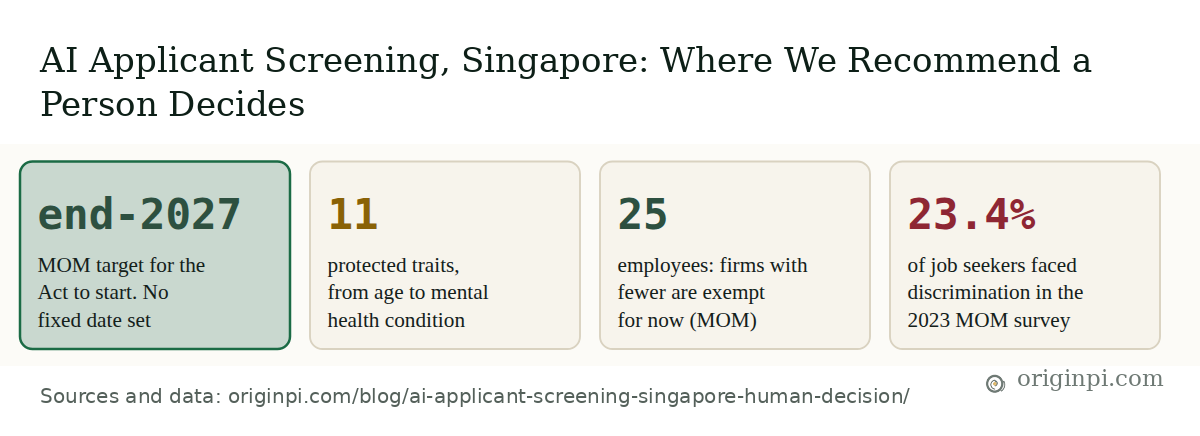
MOM aims for the Act to start in end-2027 and has not set a date. Until then, the Tripartite Guidelines on Fair Employment Practices (TGFEP) and the PDPA already apply. We found no official text on how to run AI screening, so below we separate what the sources say from what we recommend.
At a glance: the Workplace Fairness Act and hiring in Singapore
MOM statements and survey, 2023 to 2025. The start date is a target, not a fixed date.
When does the Workplace Fairness Act start?
MOM has a target, not a date: end-2027. The Act came in two Bills. Parliament passed the first, on protections and employer duties, on 8 January 2025, and the second, on dispute resolution, on 4 November 2025, according to MOM's press release of that day. In his 4 November speech the Minister recalled that in January the Act was "expected to come into force in 2026 or 2027", and then set the end-2027 target. In October 2025 MOM's fact sheet said the intention was 2027.
As such, we currently target to implement the Act in end-2027, but we will continue to monitor readiness of all parties and adjust this timeline as necessary.
Dr Tan See Leng, Minister for Manpower, Second Reading speech on the Workplace Fairness (Dispute Resolution) Bill, 4 November 2025.
As of the update below, no MOM page we read gives a gazetted start date. The first Bill says the Act "comes into operation on a date that the Minister appoints by notification in the Gazette". Singapore Statutes Online refused our request for the Act, and we did not try to get around that. We read the Workplace Fairness Bill as introduced on 12 November 2024, from the Parliament website. This post quotes the Bill, not the final Act text. The Act as passed may differ, so check a clause on the statute site before you rely on it.
TAFEP is already preparing employers. Its fair recruitment toolkit of 9 July 2026 describes itself as help to "meet WFA requirements". It says nothing about AI.
Does the Act reach a hiring decision made by software?
The Bill is written around the employer and the decision. It does not mention tools. MOM's pages we read do not mention AI either. The Bill makes it discrimination for an employer to make an "employment decision" that adversely affects a person on the ground of a protected characteristic. The eleven traits in clause 8 are age, nationality, sex, marital status, pregnancy, caregiving responsibilities, race, religion, language ability, disability and mental health condition. Firms with fewer than 25 employees are exempt for a start. MOM's fact sheet of 12 November 2024 adds: "Tripartite partners will monitor the situation and review the exemption in five years."
The table sets out the clauses of the Bill as introduced that matter for screening, with our reading beside each.
| What the text says | Source | Our reading for AI screening |
|---|---|---|
| An employer "hires or decides not to hire" a person (clause 5(1)). An employer hires if it "takes any step towards an offer ... including ... inviting the individual to an interview, test or examination for the purposes of possible employment" (clause 5(2)) | Bill 50/2024 as introduced, clause 5 | A decision not to hire is an employment decision. So is an invitation or a request for documents. A tool that sorts who is invited is shaping hiring in the Act's sense |
| "Employer" includes "the duly authorised agent or manager of the employer" | Bill 50/2024, clause 2 | Handing a step to a recruiter or platform you authorise does not move responsibility away from you |
| A trait counts as it exists, or "as it is suspected, assumed or believed" by the decision maker | Bill 50/2024, clause 17(4) | Acting on a guess about age or nationality is covered, even if the guess is wrong. A tool that infers traits from a name or school gives you a guess to act on |
| A written "direction, instruction or policy" that directs decisions on the ground of a trait is discrimination, whether or not any decision follows | Bill 50/2024, clause 18 | A written scoring rule or prompt that uses a protected trait is itself a risk |
| Job advertisements must not use words that signal a preference for a protected trait | Tripartite Committee final report, recommendation 5 | Ad text from a generator needs a person's check before it goes out |
MOM also says employers may use a protected trait where it is a genuine occupational requirement, for four reasons: performance of the job, health and safety, privacy, and legal or regulatory needs. Its example: a bus company hiring trainees above the licence age of 21.
Where does hiring discrimination happen today?
Mostly at the first steps, and mostly around age. MOM's Fair Employment Practices report, released in September 2024, is the latest edition we found. The share of resident job seekers who said they faced discrimination fell from 42.7% in 2018 to 23.4% in 2023, per MOM's press release.
Interactive chart
Fewer job seekers report discrimination than in 2018, but the fall has stalled
Share of resident job seekers who said they faced discrimination during job search.
2018: 42.7%. 2021: 25.8%. 2022: 23.8%. 2023: 23.4%.
| Year | Percent |
|---|---|
| 2018 | 42.7 |
| 2021 | 25.8 |
| 2022 | 23.8 |
| 2023 | 23.4 |
By trait, age dominates: 18.1% of job seekers in 2023, up after a steady fall. Nationality also rose. MOM says the survey allows more than one answer per person, so the bars do not add up to the total.
Interactive chart
Age is by far the most reported trait in job search
Share of resident job seekers who faced discrimination in 2023, by trait. A person can report more than one.
Age 18.1%, race 5.1%, nationality 4.8%, family status 3.8%, sex 3.3%, mental health 2.9%, religion 2.5%.
| Trait | Percent |
|---|---|
| Age | 18.1 |
| Race | 5.1 |
| Nationality | 4.8 |
| Family status | 3.8 |
| Sex | 3.3 |
| Mental health | 2.9 |
| Religion | 2.5 |
The same report asked how it happened to those who faced discrimination. The top answer is the advertisement. The third is the one a screening tool can cause, being passed over.
Interactive chart
Adverts, irrelevant questions and being passed over lead the list
How discrimination happened, as a share of job seekers who faced it in 2023. Answers can overlap.
Advert stated a preference 45.7%. Irrelevant personal information asked 28.3%. Told not shortlisted or selected because of a trait 28.3%. Derogatory remarks at interview 15.2%. Offered a smaller role 8.2%.
| What happened | Percent |
|---|---|
| Advert stated a preference | 45.7 |
| Irrelevant personal data asked | 28.3 |
| Told not shortlisted or selected | 28.3 |
| Derogatory remarks at interview | 15.2 |
| Offered a smaller role | 8.2 |
None of these figures measures AI. They show where complaints already sit: the advert, the form and the shortlist. Those are three places where firms often put automated tools, so a tool trained on old habits can repeat them at scale.
Where do we recommend a person decides?
A person decides at every step that removes someone from the process, and at the step that makes the offer: five steps, shown below. Our rule, not a legal one. Three sources point the same way. The Bill as introduced treats a decision not to hire, and a step towards an offer, as the employer's employment decision. TAFEP's Fair Recruitment and Selection Handbook, updated in November 2025, asks for consistent, merit-based criteria for shortlisting, tests that are "free from bias in content or scoring", and a record of the interview, assessment process and offer "for at least one year". And PDPC's guidelines say that, for outcomes with a higher impact on a person, a firm may wish to consider telling people how "human agency and oversight" works.
Where we recommend a person decides, step by step
Grey boxes are what a tool may do. Green boxes are the human decision we recommend at each step.
The rule for each step, in the order a candidate meets it:
- Advert. A tool may draft and target it. A named person reads the final text and the audience before it goes live. Check for any wording that signals a preference for a protected trait.
- Application form or chatbot. A named person owns the question list. Delete any field the job does not need, such as age, race, religion, marital status or family plans, unless it is a genuine occupational requirement.
- Shortlist. The tool may rank. It may not decline anyone, and it may not decide who is invited on its own. A named person reads the written criteria and the reason for each person cut, then signs. The Bill as introduced treats the invitation as a hiring step, so this person also owns the invite list.
- Assessment. A score is evidence, never the verdict. A person reads the answers behind the score and writes the reason for the call.
- Offer or final rejection. A person decides and records why. The tool drafts the letter only.
A name on the log is not enough. The person needs the criteria, the power to overrule, and time to read.
A person can still be a rubber stamp. A recruiter who clicks approve on 300 rankings without seeing the criteria adds only a name. Our post on approvers covers that failure, and the confirm step pattern helps.
Illustrative example: a 40-person firm uses software that scores 300 applications for one role and drops the lowest 200 with a template email. Under our rule the tool can still rank. Before any email goes out, a named recruiter checks the 200 against the written criteria, and the log records the person, the date and the reason. If 200 is too many to read, narrow the front door with two job-related screening questions. Do not shorten the review.
Walk through your own tool below. Nothing you choose leaves your browser.
Decision tree
Where do we recommend a person decides in your hiring step?
Up to three questions. A guide built on our rule, not an audit and not legal advice. Each outcome says whether it rests on the law, on guidance or on our recommendation.
- Advert: a person signs off the advert. A tool may draft and target it.
- Form or chatbot, asks for anything the job does not need: remove the field.
- Form or chatbot, job-related questions only, no notice shown to candidates: add the notice first.
- Form or chatbot, job-related questions only, notice shown: the tool may collect, and a person owns the questions.
- CV scoring, the tool can drop a candidate with no person looking: we recommend a named person decides each rejection.
- CV scoring, a person sees every rejection, criteria not written or not the same for all: write the criteria first.
- CV scoring, a person sees every rejection, criteria written and the same for all: the tool may rank, and a person decides and records.
- Interview, voice or test scoring: a person decides, never the score alone.
- Offer or final rejection: a person decides and writes down why.
What must candidates be told, and what is only advice?
The law requires you to state the purposes. Everything else here is advice. Section 20 of the PDPA requires an organisation to inform people of the purposes for which their data is collected, used and disclosed. That is the legal duty. Separately, the PDPC's Advisory Guidelines on use of personal data in AI recommendation and decision systems, issued on 1 March 2024, say what good notices cover: what the data is for and what the tool looks at (paragraph 9.5). For higher-impact outcomes, paragraph 10.6(c) suggests telling people about human agency and oversight, which is where whether a person checks fits. They are "advisory in nature", so they are not law.
PDPC encourages notices that cover the function that needs the data, the types of data and how they relate to the result. It says notices "need not be overly technical or detailed" and should fit "the risks of each use-case", including the "level of autonomy of the AI System". It suggests a short notice that links to a fuller policy.
We found no source that says a candidate must be told they are talking to a bot. We recommend it anyway, because a notice that skips the tool cannot explain what the data is for. The check below mixes PDPC points, TAFEP practice and our own, with our weights. Each item names its source.
Self-assessment
Is your candidate notice ready?
Tick what is true today. Heavier items count more. A guide, not an audit. Nothing you enter leaves your browser.
- 0 to 39%: Notice not ready. Start with the first group: a tool is used, why you collect data, and whether a person checks.
- 40 to 74%: Partly ready. Close the gaps in the first group, then add the layered policy and the records.
- 75% and above: Ready to review. Have a lawyer read the final wording before you publish it.
Weights are illustrative; total 22 points. Based on the PDPC guidelines of 1 March 2024 and the TAFEP handbook of November 2025. The PDPC guidelines are advisory. Not legal advice. Nothing you enter leaves your browser.
With a vendor's screening product, ask what data it reads, whether it can reject without a person, and how long it keeps logs. Our guides to what to log and PDPC's generative AI guidance cover the vendor side.
Where Origin Pi stands
Our view of applicant screening is simple. A tool may help. The open question is which act belongs to a named person. Origin Pi designs that line in AI governance and AI compliance work.
MOM may still move its target date. The TGFEP already applies to every employer, and the PDPA to every firm that holds candidate data, including those under 25 employees.
This week: list every hiring step where software touches an applicant, mark each that can reject or invite with no person looking, and name its owner. Then run the notice check above.
Take the data with you
Every figure in this post's charts and at-a-glance card is in one table, with its source, source date and the date we read it. If you reuse either file, please cite this post and link back to it.