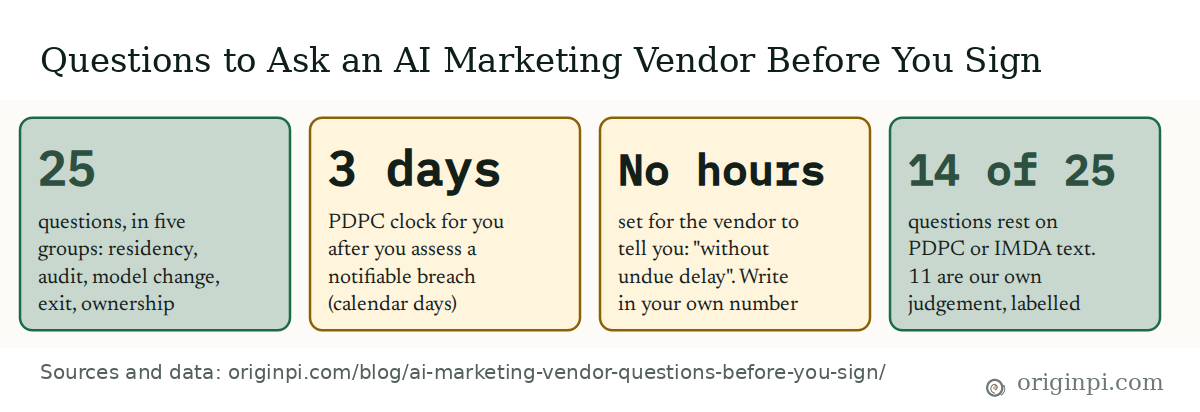
Get written answers to twenty-five questions in five groups before you sign with an AI marketing platform, or an agency that uses AI. The groups are where your data goes, who touched it, what happens when the model changes, how you leave, and who owns what. You stay accountable for the data and the messages even when a vendor runs the tool, and the vendor's answers are your evidence. This is for the owner or marketing lead who signs, and for whoever in IT or compliance checks. The full list is at the end, ready to copy.
Jurisdiction: the legal references here are Singapore ones (PDPA, PDPC, IMDA and the Singapore Do Not Call Registry). Readers elsewhere should map them to local law.
The guidance is recent: the PDPC's Advisory Guidelines on Use of Personal Data in Generative AI date from 20 July 2026, and IMDA's agentic AI framework is at version 1.5 (20 May 2026, updated 5 June 2026). This is general information, not legal advice and not a compliance test. Contract terms should be reviewed by qualified counsel. Our post on buying an AI agent covers stop controls and agent contracts. This one covers the platforms and agencies that handle your lists, ad accounts and content.
At a glance: one list, two breach clocks
Clocks are from the PDPC clauses guide. The 14 of 25 count is ours.
Who is accountable when a vendor runs AI on your marketing data?
You are. When a platform or agency runs generative AI on your customer lists, ad accounts and content, the PDPC puts primary responsibility on the business that chose the system. The vendor is usually your data intermediary, meaning it processes personal data for you, and it carries only some duties itself. The rest stay with you.
The July 2026 guidelines are advisory, and the PDPA prevails over them. They still show what the regulator expects of a buyer.
System Deployers bear primary responsibility for ensuring that the Generative AI Systems they have chosen to use can meet their obligations under the PDPA. When procuring systems, they must therefore ensure that they have sufficient information on upstream safeguards to conduct a holistic assessment.
PDPC, Advisory Guidelines on Use of Personal Data in Generative AI, paragraph 9.1, 20 July 2026.
"Sufficient information" means the vendor's answers, in writing, before you sign. The PDPC's guide on data protection clauses (1 February 2021) explains the split. A contractor handling personal data for you "will likely be considered as a data intermediary". Under a written contract it is bound mainly by the protection and retention duties. You decide whether a breach is notifiable.
Marketing adds two wrinkles. An agency's AI tool is another vendor behind your vendor, and the model it calls may be a third. The generative AI guidelines treat a model provider that runs inference or hosts your data as a data intermediary (paragraph 7.4), and one that uses prompts to develop its own models as an organisation in its own right (paragraph 7.1). And the clauses guide reminds readers that an organisation sending marketing messages to Singapore telephone numbers, "whether for its own purposes or for another organisation", must meet the Do Not Call Registry duties. Our post on the pre-send DNC gate shows what that check looks like.
Where your data goes, and where each question group bites
Numbers match the five groups. The dashed box is the part most buyers never see.
Data residency: where does a vendor keep and run your data?
Ask where your data is stored, where the model runs and who else can see it. The PDPC says it is good practice for model providers to document and make available the measures they take to safeguard personal data, such as residency and retention policies and incident response. Its example is a data storage info sheet with high-level detail on where customer data is stored and processed (paragraph 7.5). Its sample clause 2.3 bars transfer outside Singapore without your prior written consent.
That clause is a sample to adapt, not a legal rule. If you agree to a transfer, it asks for a written undertaking of protection comparable to the PDPA, from the vendor and from any overseas third party.
The five residency questions (R1 to R5) ask which countries, whether transfers need your written consent, whether an undertaking of comparable protection comes with it, whether your content trains any model, and who the sub-processors are. The training question matters most in marketing, because lists and creative briefs are what a vendor might reuse. The sub-processor question draws on IMDA's advice to require "disclosures on agent capabilities and data handling practices" from external parties (framework section 2.2.1).
Illustrative example: a 15-person retailer wants an agency to run an AI tool over a newsletter list of 12,000 subscribers. The agency says the tool is "hosted by a partner". The retailer holds the list back and sends the residency questions plus a 50-row test file of fake names. The answers: servers in two countries, no written consent step, prompts kept to improve the tool. The retailer asks for a consent clause and a no-training clause. If the agency declines, the list stays put.
Audit trail: who or what touched your customer data?
A usable audit trail names the actor, the data touched and the time for each action the AI takes in your CRM, email platform or ad accounts. IMDA says that after deployment you should "ensure all agent actions are logged and attributable". For external providers it asks for "scoped API keys, per-agent identity tokens, and observability such as the logging of tool calls and access history."
The next sentence gives the buyer bargaining power: "Where such features are lacking, organisations should consider alternative or in-house solutions, or scoping down the agentic use case, such as restricting access to sensitive data." If a platform cannot show a log, it should not get your full customer database. The PDPC's example of a sales assistant (paragraph 9.5) shows the shape: role-based limits on its file and network access, and escalation of complex tasks to people.
The six audit questions (A1 to A6) ask for a log export, scoped credentials per agent, visible prompts and outputs, how long those are kept, a breach-notice time in hours, and a named Do Not Call check. The breach question (A5) exists because of a gap in the PDPC guide: the vendor must tell you "without undue delay", with no number. A slow vendor delays the facts you need for your own assessment, and the three-day PDPC notification runs from your assessment that a breach is notifiable. That is why the contract should state hours. The PDPC's breach guide (revised 15 March 2021) says an organisation must "take reasonable and expeditious steps to assess whether the data breach is notifiable under the PDPA within 30 calendar days", and that "Any unreasonable delay in assessing a data breach will be a breach of the DBN Obligation". The 30 days is a limit, not a grace period. For what to log and how long to keep it, see our post on the AI system of record.
Model change, exit and ownership: what do you keep when things move?
Outputs change when the model, the prompt or a connected tool changes, even if none of your campaign settings did. IMDA lists model updates and tool modifications as triggers for a change review. A changed model can shift brand voice or drop a required disclosure, and the ad carries your name. Our post on brand-voice drift covers that failure.
The five model-change questions (M1 to M5) ask which model runs your work, what notice you get, whether you can stay on the tested setup while you retest, what checks run before publishing, and who approves. IMDA's summary states the point behind the last: "Humans must remain accountable and properly manage these risks."
Exit has two halves. The PDPC half covers personal data. Sample clause 2.7 has the vendor return or delete all of it on request, give "written confirmation that it no longer possesses any Customer Personal Data", and instruct third parties to do likewise. Sample clause 2.9 adds that the contractor indemnifies you against losses from its own or its subcontractor's breach. The commercial half, who owns the accounts, audiences and content, is in none of this guidance, so you write it down yourself.
The exit questions (E1 to E5) cover deletion with written proof, third parties, how long logs and backups survive, export format, and the contract term, including whether it renews on its own. The ownership questions (O1 to O4) cover accounts in your name, audiences, creative and settings, and the indemnity. Who owns AI-made content in law is a separate question this post does not cover. These are contract terms.
How much of the list is sourced, and how do you read the answers?
Fourteen of the 25 questions trace to PDPC or IMDA text, and eleven are our own judgement. The chart counts them by the document behind each question. The eleven sit mostly in model change, exit, ownership and breach notice, where the sources are silent or say little. We count A5 (breach notice in hours) and E3 (how long logs and backups survive) as our judgement, because the PDPC guide gives no number of hours and does not set a survival period for logs. That is a reason to push on them, not to drop them.
Interactive chart
Six questions come from the PDPC clauses guide, eleven are our judgement
Number of the 25 questions in this post, by the document that backs each one. Each question is counted once, under its main source.
PDPC clauses guide: 6 (R2, R3, A6, E1, E2, O4). IMDA framework: 5 (R5, A1, A2, M1, M2). PDPC generative AI guidelines: 3 (R1, R4, A3). Origin Pi judgement: 11 (A4, A5, M3, M4, M5, E3, E4, E5, O1, O2, O3).
| Backing document | Questions |
|---|---|
| PDPC clauses guide (Feb 2021) | 6 |
| IMDA agentic framework v1.5 | 5 |
| Origin Pi judgement | 11 |
| PDPC generative AI guidelines | 3 |
Treat a specific answer with a document behind it as evidence, and a general reassurance as a gap. Vendors rarely refuse outright. They answer a different question. The readings below are our judgement.
| What the vendor says | What to read into it |
|---|---|
| "Your data stays in the region." | Region is not country. Ask for the list in R1 and the consent clause in R2. |
| "We never train on customer data." | Ask for it in the contract, and ask whether the model provider behind them says the same. |
| "Logs are available on request." | No fields, format or deadline. Ask for a sample export first. |
| "The agent uses our service account." | No per-agent identity. You cannot tell the agent from a person. |
| "We will notify you promptly." | Not a number. Ask for hours. |
| "You can export your reports." | Reports are not accounts, audiences or settings. Ask O1 to O3. |
| "We are PDPA compliant." | A label, not a document. Ask which clause or evidence backs each answer, as the email asks. |
| "We hold a security certificate." | Ask what it covers. A company-wide certificate may not cover the AI tool or where it runs. Ask for the scope statement alongside R1 and A1. |
For compliance, the test is whether each answer can be filed as evidence. For the marketing lead, it is whether a campaign survives a model change. For the owner, it is whether you could leave in a month without losing your audiences.
The question list: tick what the vendor has shown you
Tick an item only when the vendor has shown it in writing or in a live demo. Large self-serve SaaS platforms usually answer through their trust centre, data processing agreement and security documentation rather than a custom questionnaire, so use the 25 questions to read those documents first and send the vendor only the ones they leave unanswered.
Checklist
Vendor question checker: 25 questions, five groups
Tick what the vendor has shown you in writing, not what it has promised. A guide, not an audit. Nothing you enter leaves your browser.
- 0 to 44%: Not ready to sign. Key answers are missing. Send the list back and ask for written answers before any data moves.
- 45 to 79%: Gaps to close. Close the heaviest gaps in the contract, or scope the vendor down to less sensitive data.
- 80% and above: Ready to negotiate. Turn the answers into contract terms and keep the evidence.
Weights are illustrative and total 50 points. Heavier items are those where the PDPC or IMDA text is most direct or the loss is hardest to undo.
Then send the whole list in one message. The box below is plain text, so it pastes into any email.
Copy and send
The 25 questions as one email
Fill in the two boxes if you like, then copy. Nothing you type leaves your browser.
To: [VENDOR]. Before we sign, please answer each question in writing by [REPLY_BY]. For each answer, give the contract clause or document that backs it.
DATA RESIDENCY
R1. Name every country where our data is stored, processed or used to run the AI, including your model provider's.
R2. Will you move our personal data outside Singapore only with our prior written consent?
R3. If we consent to a transfer, will you give us a written undertaking of protection comparable to the PDPA, and get the same from any overseas third party?
R4. Do you or your model provider use our prompts, lists or content to train or improve any model?
R5. Which sub-processors and model providers touch our data, and will you tell us before you add one?
AUDIT TRAIL
A1. Can we export a log showing which person or agent touched our CRM, lists and ad accounts, when, and what changed?
A2. Does each agent have its own scoped credential, and can we read and reduce its permissions?
A3. Can we see the prompts and outputs behind a message sent to our customers?
A4. How long do you keep prompts, outputs and logs?
A5. Within how many hours will you tell us of a suspected breach affecting our data?
A6. For messages to Singapore numbers, who checks the Do Not Call Registry, and where is that check recorded?
MODEL CHANGE
M1. Which model and version run our work, and who can change it?
M2. How much notice do we get of a change to the model, prompt or tools?
M3. Can we stay on the tested setup while we retest a change?
M4. What checks run on facts, brand voice and required disclosures before anything is published?
M5. Which named person approves before anything is published?
EXIT
E1. On request, will you return or delete all our personal data and confirm in writing that you hold none?
E2. Will you instruct every third party you passed our data to, to return or delete it?
E3. How long do logs, backups and derived data survive after we leave?
E4. In what format, and within how many days, do we get our data and campaign history back?
E5. What is the minimum term, how much notice cancels it, and does the contract renew on its own?
OWNERSHIP
O1. Are the ad, analytics and CRM accounts in our name, with you holding delegated access only?
O2. Do the audiences, pixels, lists and data created from our customers belong to us?
O3. Who owns the creative, prompts and brand-voice settings built for us, and can we take them with us?
O4. Will you indemnify us for losses from your or your subcontractor's breach of data duties?
Questions R2, R3, A6, E1, E2 and O4 draw on the PDPC clauses guide (1 February 2021), which is a set of samples to adapt. R2, R3, E1 and E2 follow its sample clauses most closely.
Where Origin Pi stands
Origin Pi builds governed AI deployments with bounded per-agent permissions, audit trails and pre-publish confirm steps, as part of our AI governance work. We would expect a vendor to be able to demonstrate the same controls, or say clearly what it lacks.
If you are still choosing between agencies, Origin Pi's marketing consultancy brand leapbuzz publishes a 10-point scorecard in its guide to choosing a digital marketing company.
This week, send the 25 questions to your top two vendors with a reply date. Treat a refusal to name sub-processors, state a breach-notice number or confirm deletion in writing as a stop sign. That rule is our judgement.
Take the data with you
Every figure in this post's charts and at-a-glance card is in one table, with its source, source date and the date we read it. If you reuse either file, please cite this post and link back to it.