Your AI tool stops working on the day its model is retired, so list every model you depend on and its shutdown date now. On 14 October 2026 OpenAI added GPT-4o, GPT-4o mini, GPT-4.1 and GPT-4.1 mini to its list, with shutdown scheduled for 14 January 2027. Anthropic has scheduled Claude Sonnet 4.5 to retire on 30 November 2026. This guide is for owners and CTOs who run tools built on someone else's model. It covers planned retirement: inventory, test set, cutover and rollback. For unplanned failure, see our guide to provider outages and fallback plans.
Update, 28 October 2026: We re-checked all three deprecation pages: OpenAI's 23 October batch (o1, o3-mini, o4-mini, gpt-image-1 and others) has now shut down, so the countdowns below run from 28 October. OpenAI and Anthropic have added no notice since 14 October.
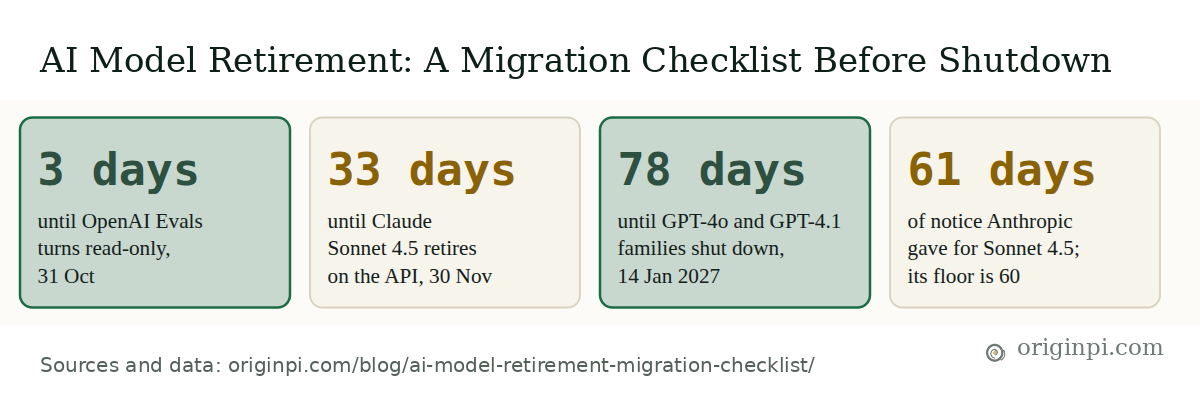
At a glance: how close are the shutdown dates?
Days counted from 28 October 2026 to the date on each vendor's own page. OpenAI's 23 October batch has already shut down.
Which AI models are being retired, and when?
Until 20 January 2027, OpenAI's page still lists shutdowns, scheduled for the Evals platform from 31 October, image models, the GPT-5 and o3 families, GPT-4o and GPT-4.1, plus voice models. Anthropic's page adds one on 30 November. We re-read all three vendors' deprecation pages for this update. These pages change, so check the live version before you plan.
The chart counts the days left from 28 October to each remaining date. The first batch is already behind us: on 23 October OpenAI shut down a set of legacy snapshots that included o1, o3-mini, o4-mini, gpt-4-turbo, gpt-4.1-nano and gpt-image-1, and its page now says access was shut down. The nearest remaining date is only three days away: on 31 October existing Evals become read-only. Then comes a cluster. On 30 November the Evals dashboard and API, Agent Builder, reusable prompts and Claude Sonnet 4.5 all end. The older GPT image models gpt-image-1.5, gpt-image-1-mini and chatgpt-image-latest go on 1 December, and gpt-5, gpt-5-mini, gpt-5-nano, o3 and the pro variants on 11 December.
Interactive chart
Eight shutdown dates fall within 84 days of 28 October
Days from 28 October 2026 to each remaining shutdown date listed by OpenAI and Anthropic. One bar covers several models that share a date.
Days left at the date of this update: the Evals read-only switch in 3, Claude Sonnet 4.5, Agent Builder and the Evals dashboard in 33, the gpt-image-1.5, gpt-image-1-mini and chatgpt-image-latest models in 34, gpt-5 and o3 in 44, text-to-speech models and new fine-tuning jobs in 70, the GPT-4o and GPT-4.1 families in 78, and older audio and realtime models in 84. OpenAI's legacy snapshots have already shut down.
| Shutdown | Days left |
|---|---|
| OpenAI Evals read-only, 31 Oct | 3 |
| Claude Sonnet 4.5, 30 Nov | 33 |
| OpenAI Agent Builder and Evals API, 30 Nov | 33 |
| OpenAI image models (1.5, 1-mini, latest), 1 Dec | 34 |
| OpenAI gpt-5 and o3 families, 11 Dec | 44 |
| OpenAI text-to-speech models, 6 Jan 2027 | 70 |
| OpenAI GPT-4o and GPT-4.1 families, 14 Jan 2027 | 78 |
| OpenAI older audio and realtime models, 20 Jan 2027 | 84 |
Two things the dates hide. First, a shutdown is not only a model. OpenAI's page also ends the Evals platform and Agent Builder, so a test harness or a workflow you built there goes with them. Second, the list is long, with notices dated from April to October. Plan for this as a routine, not a one-off. Google's Gemini API deprecations page shows the same pattern for its own models.
How much notice do the vendors give?
OpenAI promises at least six months for general-release models and three for specialised variants, Anthropic at least 60 days, and Google gives no fixed period. Those are three different promises. The 14 October notice for GPT-4o is a useful case: 14 October to 14 January is 92 days, close to the three-month minimum OpenAI lists for specialised variants. The page does not say which minimum applied, so ask your account contact.
Anthropic's model deprecations page states its rule in one sentence:
Anthropic notifies customers with active deployments for models with upcoming retirements, providing at least 60 days’ notice before model retirement for publicly released models.
Anthropic, Model deprecations, Notifications, with the 30 September 2026 Sonnet 4.5 notice on the same page.
OpenAI's deprecations page gives a longer list. Unless safety or compliance concerns require a faster timeline, generally available models get "At least 6 months", specialized variants "At least 3 months", and preview models "may be retired with much shorter notice, such as 2 weeks". Google's page says its listed dates are the earliest a model could be retired, and that it will give the exact shutdown date with advance notice.
| Vendor | What its page promises | What it means for you |
|---|---|---|
| OpenAI | At least 6 months for general release, 3 months for specialised variants, as little as 2 weeks for previews | Never build a production tool on a model with preview in its name without a plan for a 2-week exit |
| Anthropic | At least 60 days for publicly released models, by email and in the documentation | The shortest warning of the three. Amazon Bedrock and Google's managed Claude service set their own schedules |
| Listed dates are the earliest possible; exact date confirmed with advance notice | A listed date is the day to be ready by. Watch the release notes page |
Interactive chart
Recent notices ran from 61 days to 184 days
Days between the announcement date and the shutdown date for six recent notices.
Claude Sonnet 4.5 had 61 days of notice, the GPT-4o and GPT-4.1 families 92 days, the Evals platform 180 days, gpt-image-1.5, gpt-image-1-mini and chatgpt-image-latest 182 days, gpt-5 and o3 183 days, and OpenAI's legacy snapshots 184 days.
| Notice | Days of notice |
|---|---|
| Claude Sonnet 4.5 (30 Sep to 30 Nov) | 61 |
| GPT-4o and GPT-4.1 families (14 Oct to 14 Jan) | 92 |
| OpenAI Evals platform (3 Jun to 30 Nov) | 180 |
| gpt-image-1.5, 1-mini and latest (2 Jun to 1 Dec) | 182 |
| gpt-5 and o3 families (11 Jun to 11 Dec) | 183 |
| OpenAI legacy snapshots (22 Apr to 23 Oct) | 184 |
Read the chart for the spread, not for a ranking. Six notices is a small sample, and the vendors sell different things. Notice also depends on what you run. A team on the Claude API has about two months from the email. A team on GPT-4o has about three.
What does a retirement break besides the model?
The model name is only one of the places a retirement bites: saved prompts, fine-tuned models, test harnesses and no-code workflows all carry the old dependency. The diagram shows the five steps in order. It starts with finding every place the old model is used, because the step you skip is the one that fails on the shutdown date.
The five steps of a model migration
An illustrative plan; the dashed box and line mark the part that ends on the shutdown date.
Step 1, inventory. Anthropic's page suggests an audit: export the Usage page of its Console as a CSV, which lists usage by API key and model, then look for deprecated models. Do the same on any vendor's billing or usage export, and add what an export cannot show: models named in code, in saved prompts, in no-code automations and in tools a vendor built for you. OpenAI's page says fine-tuned versions follow the schedule of their base models, so list those too. OpenAI's page also lists reusable prompts, ending 30 November, and new fine-tuning jobs for existing customers, which can be created only until 6 January 2027. Check each item you use against the page.
Step 2, the test set. Vendors name a replacement for each model, and the replacement is a different model. OpenAI names gpt-6-luna for the GPT-4o family; Anthropic names claude-sonnet-5-5 for Sonnet 4.5. Anthropic's page tells you to test with the new model "well before the retirement date". Build the set from your own real tasks, and write the pass mark first.
Steps 3 and 4, shadow run and cutover. Run the new model on live inputs without showing anyone the answer, compare, then move a small share. Log which model answered every request, as the outage guide suggests for fallbacks, and the system-of-record guide explains how to keep that log.
Step 5, the rollback window. This is the part people forget. Anthropic's page says requests to models past the retirement date fail. Until then the old model is your rollback, and after it you have none. So the plan must finish its checks, and keep the old model on, until near the end. Anthropic's page also warns that deprecated models "are likely to be less reliable than active models". So do not stay on one longer than you need.
How long does a migration take, and when must you start?
Add up the five steps in days and take the total away from the days left: the remainder is your slack, and below zero you are already late. The what-if below does the sum. The presets load real dates from the chart.
Illustrative example: a small firm runs a support triage tool on GPT-4o mini. The owner gives inventory 5 days, the test set 7, the shadow run 7, cutover 2 and a rollback window of 7. That is 28 days. Against the 78 days until 14 January 2027, the slack is 50 days. If the same firm ran Claude Sonnet 4.5, with 33 days left, the slack is 5. The numbers are invented; the method is the point.
Migration what-if
Do you have time before the shutdown date?
Enter the days each step will take. The preset loads the days left from 28 October 2026.
How it is calculated: needed = inventory + test set + shadow run + cutover + rollback window. Slack = days you have minus days needed. Days short = needed minus days you have, if positive.
Illustrative defaults, not measured data: use your own estimates. Nothing you enter leaves your browser.
With the defaults, the Claude Sonnet 4.5 preset leaves 5 days of slack and the 31 October Evals preset leaves you 25 days short. Nobody can fix the second one by working harder. The answer is a decision made earlier: whether the old model was still doing work you could not move in time.
What belongs on a migration checklist?
One sheet with five rows, each with an owner and a date, plus ten checks grouped into what you know, what you tested, and what you can undo. A plan with no names and no dates is a wish. Here is the sheet for the Sonnet 4.5 case, using the 28 days from the what-if above and starting on 28 October.
| Step and owner | By | Pass condition |
|---|---|---|
| 1 Inventory, head of operations | 2 Nov | Every use on one list, with its shutdown date |
| 2 Test set, owner of the tool's output | 9 Nov | Real tasks collected, pass mark written first |
| 3 Shadow run, technical lead | 16 Nov | New model meets the pass mark on live inputs |
| 4 Cutover, technical lead | 18 Nov | All traffic moved, each answer logged by model |
| 5 Rollback window, CTO | 25 Nov | No regressions; old model stays available to 30 Nov as a spare, then retires |
Illustrative example: roles and dates are ours, to show the shape. Put real names beside yours. Then tick what is true today below; the weights are ours and a guide, not an audit standard.
Self-assessment
Are you ready for a model to be retired?
Tick what is true now. Heavier items count more. Nothing you enter leaves your browser.
- 0 to 39%: Exposed. A shutdown date could reach you before you have tested anything. Start with the inventory.
- 40 to 74%: Partly ready. Some pieces exist. Close the heaviest gaps first.
- 75% and above: Ready to cut over. Score the new model against your pass mark and keep the old one on until its last day.
Weights are illustrative. Total 22 points. Not an audit standard.
The last item matters more than it looks. Anthropic's page says Amazon Bedrock and Google's managed Claude service set their own retirement schedules, so a model's dates can differ by where you buy it. Our guide to questions before buying an agent covers the contract side, including who tells you when a model changes.
Where Origin Pi stands
Treat a model retirement as a governed change, with OpenAI's first batch already shut down and 78 days left to GPT-4o's. We think it needs an owner, a test set, a record of which model answered, and a way back. Our AI governance work designs this with the client. We build the inventory of models and where they run, the test set from real tasks, the staged cutover with the confirm step before anything that commits the business, and the log that finds the work touched.
A retirement comes with a notice period; an outage does not. The same record helps with both, which is why continuity planning and migration planning belong in one place.
Your first step: open the deprecations page for each vendor you use, write each model's shutdown date next to it in one list, and name the person who owns that list.
Take the data with you
Every figure in this post is in one table, with its source, source date and the date we read it. If you reuse either file, please cite this post and link back to it.