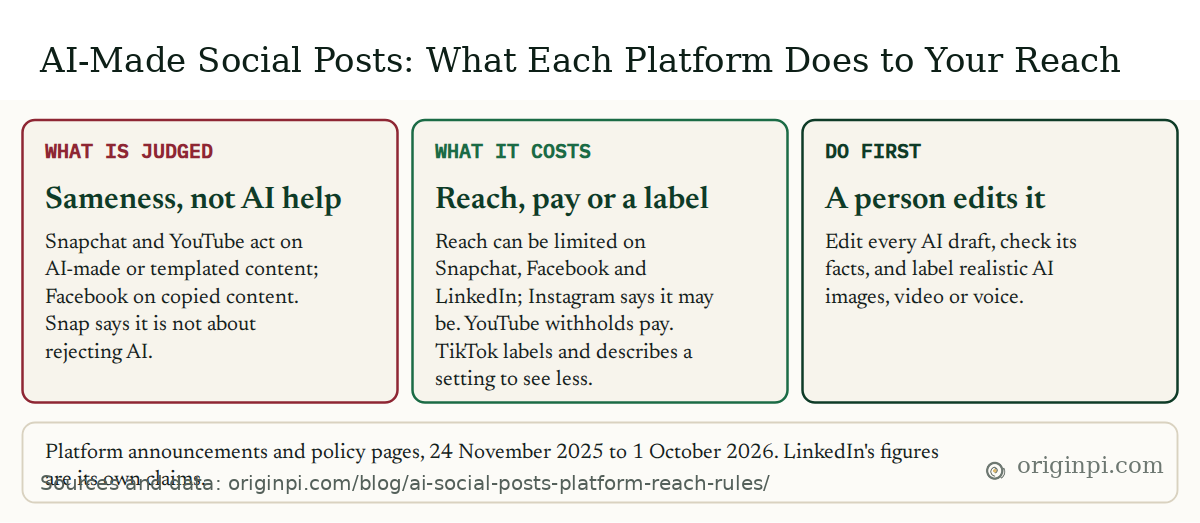
Platforms are not punishing AI help; they are cutting the reach, pay or visibility of copied, templated and fake-person content. On 31 July 2026 Snapchat stopped recommending wholly AI-generated videos on Spotlight. On 31 August 2026 Instagram said profiles that feature an AI-generated person without a label may see limits to their reach. YouTube withholds ad pay from templated channels, and LinkedIn added a Seems like AI slop button on 30 July 2026. This is for owners and CMOs who publish on social, and it settles one decision: nothing AI-drafted goes out without a named person's edit.
Policy text below comes from each platform's own page. Three things do not. LinkedIn's change and every LinkedIn figure come from news reports of its executives' words, and the figures are the company's own claims. The YouTube date of 16 July 2026 comes from news reports, and YouTube's help pages carry no date. The pages change often, so this reads as of 11 October 2026.
Update, 28 October 2026: We re-read the Snap, Meta, Instagram, YouTube Help, TikTok, TechCrunch and Engadget pages cited here and found no change to the policies, dates or figures below. LinkedIn's slop button, TikTok's three-billion label count and Instagram's "may see limits to reach" wording all stand as written.
At a glance: what platforms do with AI-made posts
Three findings and one first step, each sourced below.
What does each platform now do with AI-made posts?
Six platform surfaces now treat AI-made posts differently, and they differ on whether the cost is reach, pay or only a label. Snapchat and Facebook act on recommendation. Instagram acts on a profile. YouTube acts on money. TikTok labels and describes a setting for viewers. LinkedIn collects reports and tunes classifiers. None of them is a ban on posting.
| Platform | Announced | What it judges | What can happen |
|---|---|---|---|
| 30 Jul 2026 | Posts members report as seeming like AI slop | Classifiers expected to cut low-quality posts in recommendations beyond your network | |
| YouTube | Clarified 16 Jul 2026 (per TechCrunch; help pages undated) | Templated channels; AI personas on sensitive topics | No ad pay for the channel |
| Mar 2026 | Unoriginal content | Deprioritised in Feed and Reels; repeat posters may be deemed non-recommendable and demonetised | |
| 31 Aug 2026 | Profiles featuring an AI-generated person, unlabelled | Reach may be limited; profile may lose recommendation eligibility | |
| TikTok | 24 Nov 2025, 1 Oct 2026 | Realistic AI content must be labelled | Labels; TikTok describes a setting to see less AI |
| Snapchat | 31 Jul 2026 | Wholly AI-generated videos | Not recommended on Spotlight |
The LinkedIn row rests on reporting. TechCrunch reported on 30 July 2026 that LinkedIn removed its "enhance your post" writer and replaced it with a proofreader, and that its chief product officer, Hari Srinivasan, expects the new classifiers to reduce slop (TechCrunch, 30 July 2026). The YouTube date comes from TechCrunch too, which reported a 16 July 2026 rollout to Partner Program members (TechCrunch, 20 July 2026). The 16 July date is from TechCrunch's report; YouTube's help pages are undated, so the policy text below is quoted as the pages stood when we read them, and we cannot say when each line was added.
Three ways a platform finds out, and what it does
What the platform looks at, and what can happen to a post or an account.
Is AI itself the problem, or something else?
The common target is sameness: content that looks mass-produced, copied, or fronted by a person who does not exist. Snap states the line plainly in its newsroom post of 31 July 2026.
As of this month and going forward, wholly AI-generated videos will no longer be eligible for recommendation on Spotlight.
Snap, Rewarding Authentic Creativity on Spotlight, 31 July 2026.
The same post says: "This is not about rejecting AI." Content enhanced or edited with Snapchat's own AI creative tools stays eligible and carries transparency indicators. So the test is whole versus assisted.
Facebook's wording is about originality. Its March 2026 post says content that is duplicative or has minor edits to another creator's post "will be considered unoriginal and deprioritized," and that creators who keep posting mostly unoriginal material "may see their account deemed non-recommendable and demonetized" (Meta, March 2026). The post does not mention AI at all. AI makes copying cheap, but the rule is about whose work it is.
YouTube's help page bars "AI-generated content made with generic or unoriginal templates giving the impression of mass production". It also bars channels that use AI-generated personas to present themselves as human experts on health, legal issues, finances or politics: they "will not be allowed to monetize" (YouTube Help, Monetization policies). That is a monetisation rule.
Instagram draws the same line for people. Creators "who simply use AI tools as part of their creative process don't need to add the label"; profiles featuring an AI-generated person do, or "may see limits to their profile's reach" (Instagram, 31 August 2026).
Interactive chart
What the platforms say their changes achieved
Size of each change the platform itself reports, in percent. The direction is in the label. None of these figures is independently verified.
Snapchat: Spotlight contributors up more than 120%. Facebook: original Reels views about doubled. LinkedIn: views on posts it classifies as slop down 40%. Facebook: impersonation reports about large creators down 33%.
| Claim | Change (%) |
|---|---|
| Snapchat: Spotlight contributors, rise | 120 |
| Facebook: original Reels views, rise | 100 |
| LinkedIn: views on slop-classed posts, fall | 40 |
| Facebook: creator impersonation reports, fall | 33 |
These are the platforms' own claims about their own changes. None says a human edit raises reach, and we found no independent measurement of that. LinkedIn's number deserves care. Srinivasan wrote that members "are now experiencing 40% less views on what we classify as AI slop from just a few weeks ago" (Engadget, 21 August 2026). The classification is LinkedIn's own, and it has not published how it decides. Engadget also reports that the button "has been used more than a million times since its launch", per Srinivasan's update (Engadget, 21 August 2026). That count is LinkedIn's own figure.
Which AI posts must you label?
Realistic AI images, video and voice need a label on TikTok and YouTube; a post that is clearly stylised, or an AI-assisted edit of your own words, does not. TikTok says it requires people to label realistic AI-generated content (TikTok, 24 November 2025). YouTube says "We require creators to disclose AI-generated or altered content that seems realistic" (YouTube Help).
YouTube's examples include footage that makes a real person appear to say or do something they did not. Its help page says labels on the video player appear for music or photorealistic AI content, and creators can switch the "AI use" setting on in YouTube Studio during upload.
TikTok says its efforts, including C2PA Content Credentials (metadata that records how a file was made), had labelled over 1.3 billion videos by 24 November 2025. By 1 October 2026 it said it had labelled over three billion videos as AI generated (TikTok, 1 October 2026). In November 2025 it also said it was testing invisible watermarks.
Interactive chart
TikTok's count of labelled AI videos more than doubled in ten months
Videos TikTok says it has labelled as AI-generated, cumulative, in billions. Both figures are stated as "over". The two counts may not be defined identically.
Over 1.3 billion on 24 November 2025 and over 3 billion on 1 October 2026.
| Date | Videos labelled |
|---|---|
| 24 Nov 2025 | 1.3 |
| 1 Oct 2026 | 3.0 |
TikTok is the one platform here that describes viewer control. It said in November 2025 that it would test an AI-generated content setting in "Manage topics", so people who want less can "dial things down" rather than removing the content entirely. By 1 October 2026 it described this as a feature that lets people choose how much AI-generated content they see. It did not say whether every user has it.
Meta's rule for organic posts is older: its AI info label applies when it detects industry-standard AI markers or when people disclose, and the label moved into the post menu for content only edited with AI tools (Meta, labelling approach, page byline updated October 2025). Check the current wording in each app before you rely on it.
What does a human edit change?
A human edit is the step you control, and it can address what the platform pages above target. They do not ask who typed the words. Most of them concern labelling, copied or templated content, and misleading material. Snap's rule concerns wholly AI-generated video only. A named person can check each of those before the post goes out.
Here is the workflow we use for AI-assisted social copy. It is our practice, not a platform requirement.
- Brief. A person writes the point of the post in one sentence: the claim, for whom, and what they should do.
- Draft. AI produces a first version from that brief and your approved facts.
- Rewrite. A named person rewrites it in the company's voice and cuts every sentence that could appear on any competitor's page.
- Add. The person adds one thing only your business can say: your own data, a customer question you answered, a decision you made and why.
- Check. Every number, date and name is checked against a source and linked.
- Label. Realistic AI images, video or voice get the platform's AI label.
- Approve and log. A second person or the owner approves, and the post and its approver are logged.
Illustrative log line: "Tue 14:10. LinkedIn post. Brief: Priya. Rewrite: Dan. Added: our own Q3 enquiry count. Facts checked against the source link. No AI imagery. Approved: Priya." One line per post, kept in a shared sheet, is enough to answer "who signed this off" later.
Illustrative example: a ten-person firm drafts 10 posts a week with AI. At the check step, 3 contain a figure nobody can source, so they are fixed or dropped. At the add step, 2 turn out to have nothing only the firm could say, so they are cut. 5 go out. The numbers are made up; the point is that the edit step removes posts, not only words.
Self-assessment
Is your AI social workflow safe to run?
Tick what is true now. Heavier items count more. A guide, not an audit. Nothing you enter leaves your browser.
- 0 to 39%: Exposed. Start with a named editor and a fact check.
- 40 to 74%: Partly covered. Close the heaviest gaps first.
- 75% and above: Covered. Keep the approval log and re-run this each quarter.
Weights are illustrative. Total 17 points.
Can this post go out as it is?
A post can go out once a named person has edited it and every required label is on. Snapchat's 31 July 2026 rule covers only wholly AI-generated video, and Instagram's 31 August 2026 rule only profiles with an AI-generated person. Use the tool below with one post in mind. It reflects the platform pages above and our reading of them; it is not legal advice or a platform ruling.
Decision tool
Can this post go out as it is?
Pick what the post is. A guide built from the platform pages above, not a ruling. What you choose here stays in this page; it is not sent anywhere.
- Post it: text written with AI help, once a named person has rewritten it and checked every fact.
- Edit first: an unedited AI text draft is the sameness the platforms are acting on.
- Disclose it: a realistic AI image, video or voice needs the platform label before you publish.
- Usually no label, but check the app: clearly stylised AI media; Snapchat does not recommend wholly AI videos on Spotlight.
- Label the profile, and do not pass it off: an AI-made person or presenter must never be presented as a real expert.
- Add real commentary or get permission: a repost or clip of someone else's work.
The social lead owns the workflow and the log. The owner or CMO decides which AI people and voices the brand will ever use, because those carry the sharpest penalties. Compliance checks that required labels are on, and that nothing posted under a staff name was written by nobody.
Where Origin Pi stands
Treat these rules as a floor and the edit as the product. A platform can change its policy in a week, but a post that a named person rewrote, sourced and signed off is the best defence we know of against the rules above. We have not measured how much reach it saves, and no platform has published that figure.
We design and build the layer behind that: an approved fact sheet, a confirm step so a person approves anything posted under a company name, bounded permissions so no tool posts on its own, and an audit trail of what was published where. It sits within our marketing AI work. Our related notes cover where AI assistants get their answers and which AI model to use for content.
For the organic social strategy itself, Origin Pi's marketing consultancy brand leapbuzz publishes a B2B social playbook for the AI era.
Take the data with you
Download every figure in this post as one CSV file with its source and read date, plus the at-a-glance card as a PNG. If you reuse either, please cite this post.
Your first step: pick the five posts you published most recently with AI help, and run each through the checklist above.