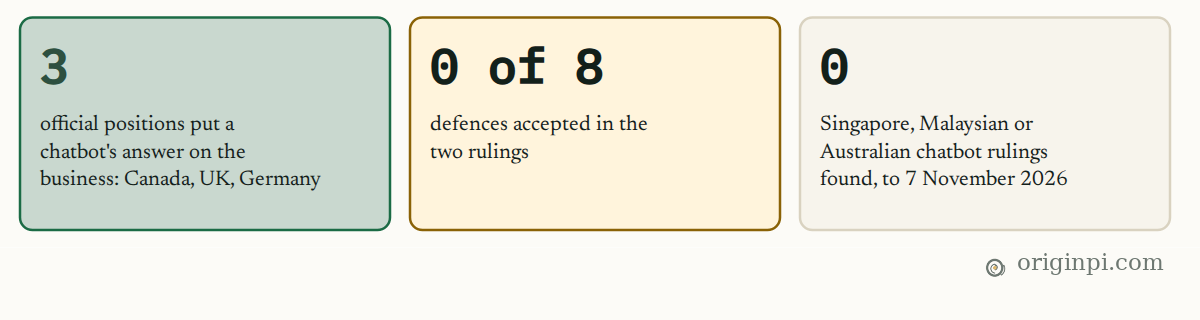
If your chatbot tells a customer something wrong, expect to own it. A Canadian tribunal and a German court held businesses to their bots' wrong answers, and the UK competition regulator says the same; neither ruling accepted that the bot, not the business, made the statement. This is general information, not legal advice.
At a glance: your chatbot's answer is your answer
Is a business liable for what its chatbot tells customers?
Yes, in the two rulings we found and in the UK regulator's guidance, so plan as if your bot's words are yours.
Timeline
Official positions on AI statements, 2024 to 2026
Select a date to see what was decided. None of these binds your courts in Singapore, Malaysia or Australia.
14 Feb 2024
Canada: airline owns its bot's answer
British Columbia Civil Resolution Tribunal, small claims. The chatbot told a customer a bereavement fare could be claimed after travel; the airline did not allow that. Negligent misrepresentation found and damages awarded. A small-claims decision; it binds no court in your market.
25 Feb 2026
Singapore: AI claims in ads covered
Written parliamentary reply from the trade ministry, to a question on ads that use AI-generated images: the Consumer Protection (Fair Trading) Act covers misleading claims by businesses, "including those involving AI-generated content". A ministry statement about ads; it does not mention chatbots.
9 Mar 2026
UK CMA: you are responsible
Competition and Markets Authority guidance: if your AI agent breaks consumer law, you are responsible, as for an employee, even if someone else built it. Guidance, not a ruling.
12 May 2026
Germany: the bot spoke for the clinic
Higher Regional Court of Hamm, case 4 UKl 3/25: a consumer association's injunction case, heard at first instance. The bot's false titles were the clinic's own misleading practice. The court gave leave to appeal to the Federal Court of Justice; its database, read 7 November 2026, marks the judgment final ("rechtskräftig").
It should be obvious to Air Canada that it is responsible for all the information on its website. It makes no difference whether the information comes from a static page or a chatbot.
British Columbia Civil Resolution Tribunal, Moffatt v. Air Canada, 2024 BCCRT 149, paragraph 27, 14 February 2024.
Which defences have failed?
Businesses have argued eight defences in these two cases, and none worked, so do not build your plan on them.
Eight defences you cannot rely on
| Defence | Rejected by | Where |
|---|---|---|
| Our chatbot is a separate entity | Moffatt tribunal | Para 27 |
| The right answer was on our other page | Moffatt tribunal | Para 28 |
| Our bot answers on its own | Hamm court | Paras 70 to 73 |
| Our bot is a third party | Hamm court | Para 77 |
| We fed it only correct data | Hamm court | Press release |
| An outside firm built our bot | Hamm court; CMA guidance agrees | Para 94 (German rule); CMA |
| We could not foresee that question | Hamm court | Paras 91 to 95 |
| Our customers know AI makes mistakes | Hamm court | Para 104 |
The Hamm clinic said its bot used only its own website texts and FAQs; the court held it liable even so. The judgment calls the bot merely a technical tool ("technisches Mittel") the clinic controlled. A prompt rule and a keyword filter later stopped the false titles, so the court expected you to prevent that before launch.
How does a wrong answer become your liability?
Your bot's answer is your statement once it is sent, so you are exposed when a customer relies on it or a rival or consumer group objects.
How a wrong chatbot answer becomes your liability
Each step, then your control at that step (green).
The CMA's guidance gives you four steps: tell your customers, train and test before launch, monitor with "a human in the loop", and refine quickly. The Hamm clinic switched its bot off but signed no binding cease-and-desist declaration, so the risk of repetition stood. What you sign after a complaint is a question for your lawyer.
What do Singapore, Malaysia and Australia say?
Each market has a consumer-law rule against misleading statements, and we found no court ruling on a chatbot's answer in the three. The Canadian and German rulings bind no court here; they show how your court may reason.
| Market | Rule and official position | Chatbot ruling? |
|---|---|---|
| Singapore | Fair Trading Act covers AI-generated ad claims (ministry, Feb 2026) | None found |
| Malaysia | Act 599 s9, s10 ban misleading conduct; excludes healthcare, regulated professions | None found |
| Australia | ACCC guidance: intent to mislead does not matter | None found |
Malaysia's Act bans false claims about a provider's "qualification or skill" or "any condition, guarantee, right or remedy", but excludes healthcare and regulated professions (section 2(2)). The ACCC says Australia's rule covers "websites or any other platform". We read both as covering your chatbot when you serve consumers; for business buyers, ask your lawyer.
Which chatbot answers need a human?
In our judgement, your bot's answers on prices, refunds, staff qualifications and advice carry the most risk: the two rulings concerned a refund answer and staff titles. Pick a statement type and who sends your answer.
Triage tool
Chatbot answer risk triage
Two questions. Tiers are our judgement built on the sources above; no court has graded them. Nothing leaves your browser.
| Your bot states | Bot answers alone | Person approves first | Bot hands over |
|---|---|---|---|
| Price, fee or term of sale | High | Medium | Lower |
| Refund, cancellation or policy | High | Medium | Lower |
| Staff qualification or licence | High | Medium | Lower |
| Claim about what you sell | High | Medium | Lower |
| Health, legal or financial advice | High | Medium, only if the approver is qualified | Lower, only if that person is qualified |
| Hours, directions, how to book | Medium | Lower | Lower |
Illustrative: asked "Is Ms Tan a trained teacher?", your tuition centre's bot should answer only from your approved staff list, or hand over.
Where Origin Pi stands
Score your bot against eight controls drawn from the two rulings and the CMA's four steps. Tick only what you have in place today.
Scorecard
Chatbot answer controls: 8 checks
Nothing leaves your browser.
- 0 to 49%: Exposed. Start with your approved list and testing.
- 50 to 89%: Partly controlled. Close your list, blocked-topic, handover and testing gaps first.
- 90% and above: Controls in place. Re-test after every change.
Illustrative weights: the approved list, blocked topics, testing and handover count 3 points, the rest 2 (total 20); missing any 3-point check keeps you below green. Not a compliance test.
Origin Pi's AI governance work builds the confirm step, access control and an audit trail; AI compliance maps them to your markets' consumer rules. Disclosing your bot is a separate duty: see our chatbot disclosure guide and, for approvals, designing the confirm step. For a second reader on your approved answer list, talk to us.
Take the data with you
Cite this post if you reuse the data.