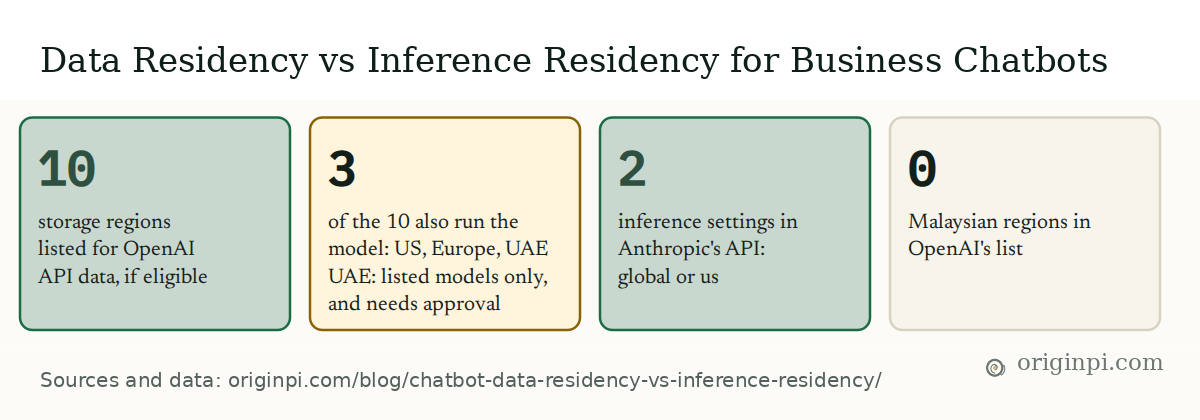
Where a chatbot stores your customers' data and where its AI model reads that data are two separate settings, and one rarely answers both. OpenAI's developer documentation lists ten regions where your data can be stored but only three where the model also runs. On that list, Singapore gives you storage only. For chatbot buyers in Singapore, Malaysia and Australia; general information, not legal advice.
At a glance: storage choices outnumber model-run choices
What is the difference between data residency and inference residency?
Data residency is where a vendor keeps your data at rest. Inference residency is where the model reads your prompt and writes the reply. Anthropic calls the two settings workspace geo and inference geo; OpenAI says regional storage and regional processing. Your vendor can offer you the first without the second.
Support for regional storage does not imply support for regional processing.
OpenAI, Data controls in the OpenAI platform. Microsoft says the same: "Data stored at rest remains in the designated Azure geography".
Where does a chatbot message travel before it is answered?
Your customer's message passes five places on its way to an answer. Your storage setting covers the last, and on some platforms part of the third; your inference setting covers the fourth.
Where a chatbot message is processed and stored
Amber: the model run. Green: storage.
OpenAI: "Data residency does not apply to system data". Amazon: cross-Region inference "can route requests to AWS Regions that are not manually enabled in your AWS account". If you take messages on WhatsApp, that platform is another place your messages pass through, so ask where it keeps them.
Which of OpenAI's ten regions also run the model?
Three: the United States, Europe and the United Arab Emirates, where only listed models run and selecting the region "requires additional approval". The other seven, including Singapore and India, store your data but do not run the model.
OpenAI's ten regions: where your data sits and where the model runs
| Region | Stores your data | Runs your model |
|---|---|---|
| United States | Yes | Yes |
| Europe (EEA + Switzerland) | Yes | Yes |
| United Arab Emirates | Yes | Listed models only, with approval |
| Singapore | Yes | No |
| India, Australia, Canada, Japan, South Korea, United Kingdom | Yes | No |
| Malaysia | Not listed | Not listed |
Eligibility goes through OpenAI sales; outside the United States you also need approval for abuse monitoring controls and a Modified Retention amendment. Logs are kept up to 30 days by default, and without regional processing "OpenAI may also process and temporarily store Customer Content outside of the Region".
What can each major provider pin?
It depends on your provider, plan and model: you set the boundary per deployment, profile or endpoint.
Coverage matrix
What each provider's documentation lets you pin
Hide columns you do not need, or show only differences.
| Provider | Your storage | Your model run | Singapore |
|---|---|---|---|
| OpenAI API | 10 regions | US, Europe, UAE (listed models, approval) | Storage only |
| Anthropic (Claude API) | One value: us | global (default) or us, Claude 4.6+ | No Singapore option |
| Microsoft Foundry Models | Designated Azure geography | Global, Data Zone (US, EU, APAC) or geography | APAC zone; no country list |
| Amazon Bedrock | Not on the page read | Geographic (US, EU, APAC) or global profile | APAC profile; only its listed Regions |
| Google Vertex AI | Location you select | Endpoint; global gives no guarantee | Singapore column; check your model |
Key: option documented · documented with limits · not offered on the page · not covered on the page read
Read 7 November 2026 (Google storage: 28 October). Malaysia: no OpenAI entry or Google column; ask. Claude on Bedrock or Google-managed Vertex follows the endpoint or profile.
Your defaults lean global: Microsoft advises "For most workloads, start with Global Standard", Google's global endpoints "don't provide any data residency guarantees", and Anthropic defaults to "global".
What do the PDPA and other regulators say about sending data abroad?
Singapore and Malaysia restrict sending your personal data overseas, and Australia keeps you accountable for what the overseas recipient does, whatever your vendor calls its plan.
| Law | Transfer test | Other routes |
|---|---|---|
| Singapore, s26(1) | Your recipient is bound to comparable protection | Contract naming countries, corporate rules, law, CBPR |
| Malaysia, s129 (1 Apr 2025) | Similar law or adequate protection | Consent, contract necessity, due diligence |
| Australia, APP 8.1 and s16C | Reasonable steps; you stay accountable | Similar law; transit routing usually a use (OAIC 8.10) |
Whether your hop counts as a transfer is a legal reading; a model run abroad on prompts with your customers' names is a strong candidate, so ask your lawyer. See also the PDPA liability gap and Malaysia's PDPA amendments for your AI vendor.
What should you ask a chatbot vendor?
Ask two questions in writing: where is my data stored, and where does the model run for my plan? Then ask your vendor for proof from your real requests.
Decision tool
Where does my chatbot's data go?
Four questions at most. A guide, not legal advice. Nothing leaves your browser.
- No personal data: only if you can show no one can be identified.
- Model region unknown: you get it in writing first.
- Global routing: your data likely goes overseas.
- Abroad, basis on file: keep your evidence; your contract names every country in a zone.
- Abroad, no basis: you stop real data.
- Model and stored data in-country, confirmed: you check your messaging app separately.
- In-country, other hops unconfirmed: you ask about your logs and sub-processors.
Scorecard
Vendor residency scorecard: 9 questions
Tick only what you hold in writing. Nothing leaves your browser.
- 0 to 39%: Promises only. You need the model region and the contract clause first.
- 40 to 89%: Partly evidenced. You close the model region and contract gaps first.
- 90% and above: Evidence on file. You re-read each provider page on a set date.
Illustrative weights, total 21 points; any 3-point item you miss keeps you below green. Not a compliance test.
Where Origin Pi stands
Origin Pi's AI governance work covers the confirm step, access control and an audit trail, so you see what an agent did; where your model runs comes from your provider and contract. For contract wording, read vendor questions before you sign; for what to log about AI work and how long to keep it, the system of record post. This week, send your vendor the two questions and ask to see the region on one real request.