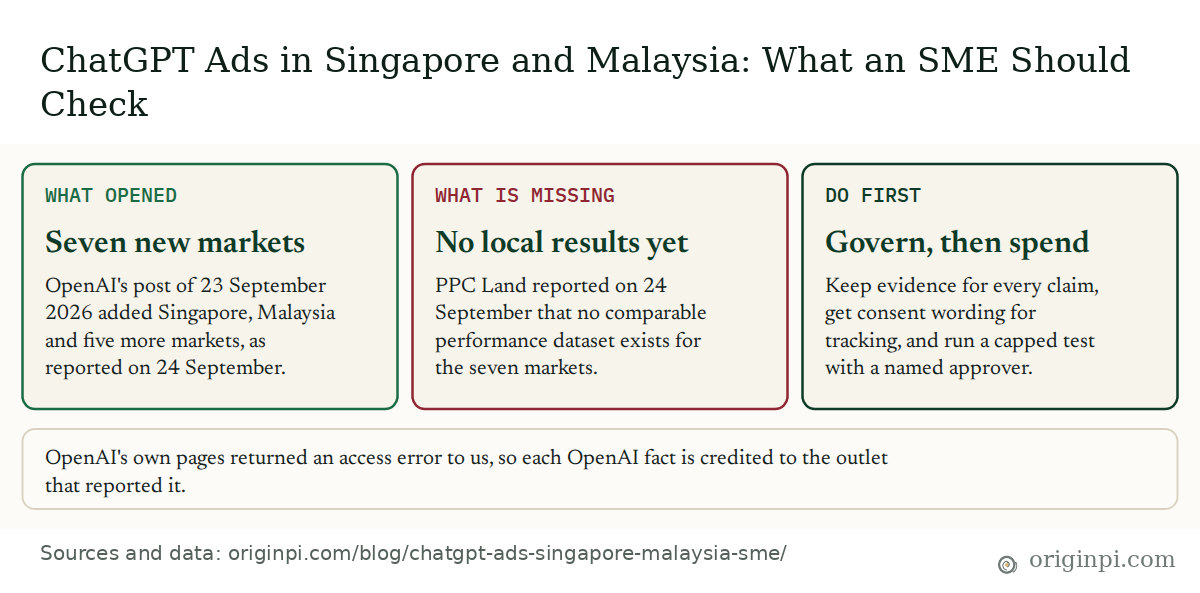
ChatGPT Ads are reported buyable in Singapore and Malaysia since 23 September 2026, with no local results yet. The first job for an SME is governance, not budget. Marketing-Interactive and PPC Land reported on 24 September 2026 that OpenAI added six Southeast Asian markets and Taiwan. PPC Land reported self-serve buying in all of them. PPC Land also reported that no comparable performance dataset exists for any of the seven. This is for owners and marketing leads deciding whether to try it, and it settles one question: what must be true before the first ad runs.
OpenAI's own pages returned an access error (HTTP 403) to us on every attempt, and we did not try to get around that. So each OpenAI fact below reads "reported by" an outlet and a date. Re-read OpenAI's pages yourself before you act.
At a glance: ChatGPT Ads in Singapore and Malaysia
Two reported facts and one first step, each sourced below.
What has ChatGPT Ads opened in Singapore and Malaysia?
OpenAI added Singapore, Malaysia and five more markets to ChatGPT Ads, with self-serve buying from day one, as reported by PPC Land. The six Southeast Asian markets (Singapore, Indonesia, Malaysia, the Philippines, Thailand, Vietnam) and Taiwan are the account in Marketing-Interactive, 24 September 2026 and PPC Land, 24 September 2026, which dates OpenAI's newsroom post to 23 September and reports the self-serve claim.
The pace matters for how much you can trust the channel. PPC Land reported that OpenAI's pilot in the United States formally began on 9 February 2026 and that a self-serve Ads Manager beta for all US advertisers followed on 5 May 2026 (PPC Land, 5 May 2026). Counting the days between those reported dates, Singapore and Malaysia got self-serve ads 226 days after the pilot began.
Interactive chart
Self-serve ChatGPT ads reached Singapore 226 days after the US pilot began
Days from the US pilot start on 9 February 2026 to each reported milestone. The day counts are our arithmetic on reported dates.
US pilot starts at day 0 (9 February 2026). US self-serve beta follows at day 85 (5 May 2026). Singapore, Malaysia and five other markets follow at day 226 (23 September 2026).
| Milestone | Days since 9 February 2026 |
|---|---|
| US pilot begins (9 Feb) | 0 |
| US self-serve beta (5 May) | 85 |
| Southeast Asia and Taiwan (23 Sep) | 226 |
PPC Land's line is blunt: "no comparable dataset exists for any of the seven new markets." Anyone quoting a Singapore benchmark for ChatGPT ads is borrowing it from somewhere else.
Who sees the ads, and who is allowed to buy?
Ads appear to Free and Go plan users, and the buyer's billed legal entity must sit in a listed country. The first part is reported by Marketing-Interactive, which says "Ads will only be shown to users on ChatGPT's Free and Go plans" and that Plus, Pro and Enterprise stay ad-free. TechNode, 24 September 2026 lists Business and Edu as ad-free too, so the outlets differ on the exact list. The second part is reported by PPC Land: the entity that advertises and is billed must be based in a country marked as available.
| What the outlets report | Who reported it | Our status |
|---|---|---|
| Seven markets, self-serve from day one | PPC Land, 24 Sep 2026 | Reported by PPC Land |
| Ads shown on Free and Go plans only | Marketing-Interactive, TechNode, 24 Sep 2026 | Two outlets; paid-plan list differs |
| Ads labelled and kept separate from answers | Marketing-Interactive, 24 Sep 2026 | One outlet quoting OpenAI |
| Billed legal entity must be in a listed country | PPC Land, 24 Sep 2026 | Reported by PPC Land |
| Measurement solutions planned | Marketing-Interactive, 24 Sep 2026 | Plans, not shipped |
| Pixel, Conversions API, 7/14/30-day click windows | PPC Land, 24 Sep 2026 | Not confirmed for the seven markets |
One practical reading: an audience on paid ChatGPT plans never sees these ads. If your buyers are senior professionals who pay for ChatGPT, the reach may be thin. That is our judgement, not a reported fact, so test it before assuming it.
Which ad claims need evidence before you buy?
In Singapore, AI-made ads face the same false-claims law as any ad, with no AI label rule planned as of November 2025. The written reply of 25 February 2026 from the Ministry of Trade and Industry (now the Ministry of Energy, Trade and Industry, METI) says the Consumer Protection (Fair Trading) Act "protects consumers against misleading or false claims made by businesses, including those involving AI-generated content", and that the competition and consumer regulator will "investigate and take enforcement action, where necessary, against egregious businesses" (MTI reply, 25 February 2026). This is general information, not legal advice.
There are currently no plans to introduce specific disclosure requirements or labelling standards
Singapore Ministry of Energy, Trade and Industry (the Ministry of Trade and Industry when it replied), written reply on disclosure and labelling for AI-generated images, 6 November 2025.
Read that quote narrowly. It concerns labelling AI-made content. It does not relax the rule on what an ad may claim, and OpenAI's labelling of its ads as ads is a separate matter from your duty to be truthful. Our rules map for AI-generated ads sets out where labels are required, and our post on who is liable for AI-made ad copy explains why the advertiser carries the claim.
The check is simple and tedious: every factual line in the ad needs a document behind it. "Fastest" needs the comparison. "Trusted by" needs the customers' permission. A number needs its source and date. A chat-style ad that sounds like a recommendation raises the bar, because a reader may take it as the assistant's own view.
Illustrative example: a Singapore bookkeeping firm drafts five ad lines. Two carry claims, "files in one day" and "most accurate in Singapore". It can show a timestamp log for the first. It has nothing for the second, so that line is cut. The evidence file now has three entries, each with a date, an owner and a link, and one named person signs off. Nothing in this example is a real firm.
The accountable person matters more than the tool. When regulators or a complaint ask who approved the line, "the platform wrote it" is not an answer.
What does conversion tracking ask of your customers?
A pixel or a Conversions API sends information about your visitors to a third party, so your consent and notice wording must cover that use before the first click arrives. PPC Land reported that OpenAI offers both, with click attribution windows of 7, 14 or 30 days from a 16 September 2026 advertiser email. The same article notes that neither Asian announcement confirms all of these settings for the seven new markets.
Interactive chart
Reported click attribution windows run from 7 to 30 days
Days after a click in which a conversion can be credited to the ad, as reported for ChatGPT Ads. Not confirmed for Singapore or Malaysia.
Three click windows are reported: 7, 14 and 30 days.
| Window | Days after click |
|---|---|
| Short | 7 |
| Medium | 14 |
| 30 days | 30 |
Three steps keep this honest. Tell visitors what the pixel does and why, in the privacy notice they can read before they click. Make your consent wording match what the tag actually sends. And give your vendor list the same attention you give any other processor: the clause below shows what a data-protection agreement can say about a breach.
The PDPA treats this as a "notifiable data breach". PDPC's model clauses for processing agreements (1 February 2021) tell the customer to notify the Commission "no later than three calendar days after the Customer has made the assessment" that a breach is notifiable (PDPC, Guide on Data Protection Clauses, 1 February 2021). Our posts on consent under the PDPA and on AI incident clocks cover the consent rule and the notification thresholds. Malaysia's rules are not mapped here. We have not read them for this topic, so ask a Malaysian adviser before you track Malaysian visitors.
Quick check
Reported or confirmed?
Five questions on the dates, plans and rules above. Pick one answer each.
Facts are as reported by the outlets named in this post on 24 September 2026. General information, not legal advice. Nothing you enter leaves your browser.
How should a small business run the first test?
Treat the first month as an experiment with a fixed size, a stop rule and a named owner, because there is no benchmark to beat. Decide the test size as a share of your paid-media total, write it down, and do not raise it until a week of data says why. That cap is Origin Pi's working rule, not a sourced figure. Review once a week with the person who approved the copy.
The mechanism below shows who holds each decision. Step 5 is dashed because OpenAI's measurement for these markets is, on the evidence we could read, planned rather than confirmed.
Five steps from deciding to buy to reading results
Who decides each step, and the control that stays with you.
Then walk the checklist. It is a guide, not an audit, and nothing you tick leaves your browser.
Pre-flight check
Are you ready to buy ChatGPT ads?
Tick what is true today. Heavier items count more. A guide, not an audit. Nothing you enter leaves your browser.
- 0 to 49%: Do not buy yet. Several basics are missing.
- 50 to 84%: Fix first. Close the heaviest gaps, then test.
- 85% and above: Ready for a capped test. Start small and review weekly.
Weights are Origin Pi's judgement and total 22 points. They are not sourced figures.
Where Origin Pi stands
A new ad channel with no local data rewards the firm that keeps its records straight. Hold the evidence for every claim, record who approved each ad, keep consent wording in step with what tags collect, and size the test before you see a single result. Those four habits cost little and make any later result believable.
We design and build the layer behind that: an approved-claims register, a confirm step so a person signs off before an ad goes live, bounded permissions so no tool publishes alone, and an audit trail of who approved what and when. It sits within our AI compliance and marketing AI work.
For the operator side of buying, Origin Pi's marketing consultancy brand leapbuzz publishes a ChatGPT ads playbook. It was published on 17 June 2026 and updated on 15 July 2026, before the September launch in Singapore and Malaysia, so use it for the buying method and not for market availability.
Take the data with you
Download every figure in this post as one CSV file with its source and read date, plus the at-a-glance card as a PNG. If you reuse either, please cite this post.
Your first step: open the evidence file, list every factual line in your draft ad, and strike any line that has no document behind it.