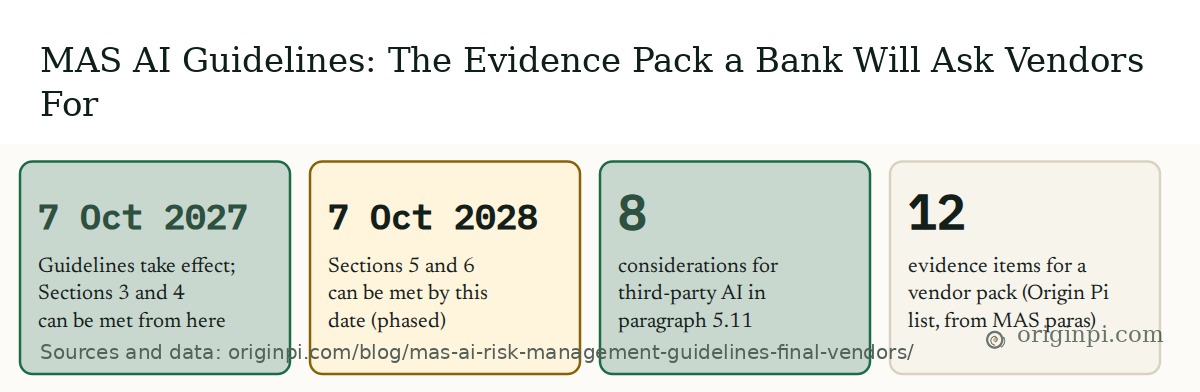
MAS's final AI guidelines do not bind AI vendors. Our reading: because every bank must show it controls the AI it buys, banks are likely to ask vendors for evidence. The guidelines were published on 7 October 2026. This post lists 12 evidence items and sorts them by MAS's two dates, 7 October 2027 and 7 October 2028. It is for the founder, CTO or compliance lead of a firm selling AI to Singapore banks, insurers and payment firms.
MAS's text puts the weight on the buyer: "the FI retains primary accountability for its use of third-party AI". Origin Pi's inference: your documentation helps the bank's compliance file, so expect requests. MAS does not say so.
This is general information, not legal advice. The Guidelines address financial institutions (FIs) and name no duty for vendors. What we call "asked of vendors" is our inference from the paragraphs that set the bank's duties. Our earlier post on MAS AI risk management in 2026 predates the final text and covers FEAT, Project MindForge and the IMDA agent framework; this one does not. Paragraph references are to MAS's Guidelines (published 7 Oct 2026); release read 28 Oct 2026. For other regulators, see which regulator's AI rule applies.
At a glance: the MAS dates and the vendor evidence pack
Dates and the count of 8 are from the Guidelines; the 12 is our list.
When do MAS's AI guidelines take effect, and who must act?
MAS's Guidelines on Artificial Intelligence Risk Management, published on 7 October 2026, will take effect on 7 October 2027. They apply to all FIs and set supervisory expectations, not vendor duties. MAS's media release says "FIs may implement the Guidelines in phases" (read 28 October 2026), and paragraph 1.8 gives the split: Sections 3 to 4 from 7 October 2027, Sections 5 and 6 by 7 October 2028.
These Guidelines take effect on 7 October 2027. FIs may meet the expectations set out in Sections 3 to 4 from 7 October 2027, and Section 5 and 6 of the Guidelines by 7 October 2028.
MAS, Guidelines on Artificial Intelligence Risk Management, 7 October 2026, paragraph 1.8.
A search for "effective date 2027" finds the first date; paragraph 1.8 holds both. Count the paragraphs per date.
Interactive chart
Sections 5 and 6 hold 29 of the 65 numbered paragraphs, and they are due later
Numbered paragraphs in MAS's Guidelines, by section. Sections 3 and 4: from 7 October 2027. Sections 5 and 6: by 7 October 2028.
Introduction: 12 paragraphs. Application: 5. AI oversight: 6. Identification, inventory and rating: 13. AI life cycle controls: 26. Capability and capacity: 3. Total 65.
| Section | Paragraphs |
|---|---|
| 1 Introduction | 12 |
| 2 Application | 5 |
| 3 AI oversight | 6 |
| 4 Identification, inventory, rating | 13 |
| 5 AI life cycle controls | 26 |
| 6 Capability and capacity | 3 |
Sections 3 and 4, on oversight and on finding, listing and rating AI, hold 19 of the 65 numbered paragraphs. Sections 5 and 6 hold 29. The vendor-heavy paragraphs, 5.10 and 5.11 on third-party AI, sit in the later group. But finding and listing a bank's AI (4.2, 4.7) is in the first group, and for bought software it needs facts only the vendor holds. Our inference: a bank that starts its inventory in 2027 will ask for those facts before the contract terms.
How does a bank's AI file pull evidence from a vendor?
Our reading of the paragraphs: a bank works in an order. It finds the AI, lists it, rates its risk, then reviews the vendor. Paragraph 4.2 says the identification process "should minimally cover" AI in services from material third-party providers, and footnote 21 names software "not explicitly sold as AI" that contains AI features. Our reading: a summary button or a chat box would count.
How a bank's AI file pulls evidence from a vendor
Green boxes are the 2027 steps and the allowed path. Amber boxes are the 2028 steps. The oxblood box is the outcome a bank wants to avoid.
When disclosure is thin, MAS tells the bank to identify the risks that arise and "put in place the necessary mitigants, such as limiting the use of AI" (paragraph 5.2). Our reading: for you, that could mean a smaller deployment.
The risk rating makes the point. Paragraph 4.12 rates a use case on impact, complexity and reliance, and for third-party AI the complexity score takes in "the level of visibility into the nature of the AI technology or the data used". MAS does not state the direction. Our reading: less visibility is likely to raise the score and bring heavier controls.
A lighter path exists. Paragraph 2.3 lets a bank apply basic policies where poor performance or unavailability of the AI "is unlikely to have a material adverse impact", and paragraph 2.4 lists drafting customer emails, summarising meeting notes and designing marketing materials with AI image generators, with a person checking. At the other end, footnote 12 says controls on transparency, explainability and fairness "may be more relevant" for AI used in credit scoring, insurance underwriting, financial advice or fund management.
What goes into the 12-item evidence pack?
Twelve items follow what the Guidelines ask a bank to know, test or control. Three serve the identification and inventory work from 7 October 2027, and nine serve the life cycle controls due by 7 October 2028. The list is ours, drawn from named paragraphs of the full text. The Guidelines contain no vendor checklist.
| # | Evidence item | MAS paragraph | MAS phase |
|---|---|---|---|
| 1 | List of AI features in your service, including ones not sold as AI | 4.2, footnote 21, 4.4 | From 7 Oct 2027 |
| 2 | Inventory-ready sheet per AI feature: purpose, scope of use, model type, data used, dependencies, status, document links | 4.7 | From 7 Oct 2027 |
| 3 | Facts for the bank's risk rating: data processed, autonomy, human involvement, visibility | 4.12 | From 7 Oct 2027 |
| 4 | Independent assessment or certification, not a self-attestation | 5.11(a) | By 7 Oct 2028 |
| 5 | Supply-chain statement: model provenance, training-data integrity | 5.11(b) | By 7 Oct 2028 |
| 6 | Commitment to notify updates and changes after deployment | 5.10, 5.11(d) | By 7 Oct 2028 |
| 7 | Contingency and exit plan, including if you end support | 5.3, 5.11(e) | By 7 Oct 2028 |
| 8 | Contract terms: audit right, data protection, notice of new AI, consent before adding AI | 5.11(f) | By 7 Oct 2028 |
| 9 | Support for the bank to test on its own data | 5.10 | By 7 Oct 2028 |
| 10 | Log and monitoring export, including actions and tools used where relevant | 5.23 | By 7 Oct 2028 |
| 11 | Version and change log for code, configuration and data | 5.25 | By 7 Oct 2028 |
| 12 | Security checklist: least privilege, encryption, data loss prevention, logging | 5.22(a) | By 7 Oct 2028 |
Each row is Origin Pi's inference from the paragraph shown; MAS names none of them as a vendor duty. Sort the twelve by type and the shape changes.
Interactive chart
Six of the 12 evidence items are documents a vendor can write once
Origin Pi's 12 evidence items, grouped by what the vendor must produce.
Documents you write once: 6 items. Contract terms: 2. Logs and records: 2. Tests and outside assessment: 2. Total 12.
| Type | Items |
|---|---|
| Documents you write once | 6 |
| Contract terms | 2 |
| Logs and records | 2 |
| Tests and outside assessment | 2 |
Eight of the twelve are paper: six documents you write once and two sets of contract terms. The other four, logs, version history, test support and an outside assessment, need systems or third parties and take longer. Start there.
Illustrative example: a Singapore software firm adds AI summaries to its meeting tool. It has four AI features. Three summarise internal notes, a use MAS lists in paragraph 2.4. One drafts replies to customer complaints. A bank may treat the first three as basic tier. The fourth gets a closer look, because wrong replies reach customers. The firm sends items 1 to 3 for all four features and adds items 9 and 10 for the complaints feature.
Which evidence will a bank accept as proof?
For transparency gaps, MAS says a bank may consider reviewing certifications or external assessments, and its brackets exclude self-attestations. Origin Pi's inference: an outside report is likely to carry more weight than a questionnaire you wrote yourself.
To address limitations in transparency, an FI may consider reviewing available certifications or external assessments of the AI provider performed by independent and competent parties (i.e. not self-attestations) that provide coverage of key risks from AI use.
MAS, Guidelines on Artificial Intelligence Risk Management, 7 October 2026, paragraph 5.11(a).
The other strong form is a test the bank runs. Paragraph 5.10 expects testing of third-party AI "in the context of the FI's use cases (including using the FI's own data)", plus "compensatory testing" where disclosure falls short. Our reading: a test account would save the bank that work. The matrix shows what each control names.
Controls against evidence
Which kind of evidence each MAS control names
Columns: document, contract term, log or export, independent report, test on the bank's own data. Hide types or show only rows where types differ. The first three rows serve 7 October 2027; the rest serve 7 October 2028.
| Bank control | Document | Contract | Logs | Report | Test |
|---|---|---|---|---|---|
| Find AI (4.2, 4.4) | AI-feature list | Notice of new AI | Not named | Not named | Not named |
| Inventory (4.7) | Attributes, links | Not named | Not named | Not named | Not named |
| Risk rating (4.12) | Visibility, data | Not named | Not named | Not named | Not named |
| Onboarding (5.10) | Disclosures | Update visibility | Not named | Not named | Own data |
| Transparency (5.11a) | Disclosures | Not named | Not named | Not self-attested | Extra tests |
| Supply chain (5.11b) | Provenance | Not named | Not named | Assessed | Not named |
| Change notice (5.11d, 5.25) | Version history | Update notice | Change tracking | Not named | Not named |
| Legal terms (5.11f) | Not named | Audit, notice | Not named | Not named | Not named |
| Contingency (5.3, 5.11e) | Exit plan | Not named | Not named | Not named | Fallbacks tested |
| Monitoring (5.23) | Records | Not named | Actions, tools | Not named | Not named |
Key: paragraph points to it · implied or related · not named
Origin Pi's reading of MAS's Guidelines of 7 October 2026: a tick means the paragraph points to that kind of evidence, and MAS names none as a vendor duty. "Not named" means the paragraph does not mention that evidence type, not that a bank would never ask. Prompts, responses and model versions (5.23(d)) are only things MAS says "could also be considered". Not an audit standard.
Paragraph 5.23 covers "all deployed AI (including third-party AI used in the FI)". In 5.23(a), where relevant, workflows that use AI should be monitored for things "such as reasoning processes, actions taken, tools used". Footnote 25 says that for AI agents, inventory attributes "may include" agent identifiers, accessible tools and systems, components and guardrails. Paragraph 5.16 says relevant technology risk guidance "would apply", and footnote 47 gives MAS's technology risk guidelines, published 18 January 2021, as an example. The checklist in item 12 comes from 5.22(a). See what to log for AI work and six proofs for SaaS agent security.
Paragraph 5.11(f) names "notification when AI is introduced and updated, or seeking the FI's agreement before incorporating AI". If your model provider swaps models often, say so first; our model provider outage plan covers that dependency.
How ready is your evidence pack, and what is still open?
Tick an item only when you can hand it over today. There are 12 items; the 3 in the first group matter first.
Evidence pack builder
Is your vendor evidence pack ready? Twelve items
Tick an item only when you can hand it over today. Heavier items count more. A guide, not an audit. Nothing you enter leaves your browser.
- 0 to 39%: Not ready to answer. A first bank request could find gaps. Start with the three items needed for the 2027 date.
- 40 to 74%: Partly ready. Some evidence is in hand. Close the heaviest gaps, starting with any outside assessment and test support.
- 75% and above: Pack ready. Update the pack when your model or features change, and re-check it each quarter.
Weights are illustrative and total 29 points. Heavier items are those a bank cannot easily replace with its own work: the early items, an outside assessment and test support. The Guidelines bind banks, not vendors, so this is a readiness check, not a compliance test.
Three things stay open as of 5 November 2026. First, MAS's release says that in 2027 it "intends to further consult the financial sector on what additional guidance on agentic AI would be useful", so agent-specific asks may grow. Second, footnote 39 says MAS's outsourcing and third-party rules also apply to third-party AI; we have not read them. Third, MAS's response-to-feedback paper is not covered.
A CTO owns items 9 to 12 and a compliance lead owns 4, 6 and 8.
Where Origin Pi stands
We design agent systems so that much of this pack exists as a by-product. In our agent-ready business layer, each agent has its own identity, bounded permissions and a fixed tool list, which makes the inventory sheet (item 2) an export. An audit trail records every call, which supports the log export (item 10), and versioned configuration supports item 11.
No design replaces an independent assessment (item 4). A good design shortens the wait for an answer.
This week, pick the AI feature a bank would examine most closely and fill in items 1 to 3 for it alone. If you cannot say what data it uses and who can change its model, nothing else helps.
Take the data with you
Every figure in this post is in one table, with its source, source date and the date we read it. If you reuse either file, please cite this post.