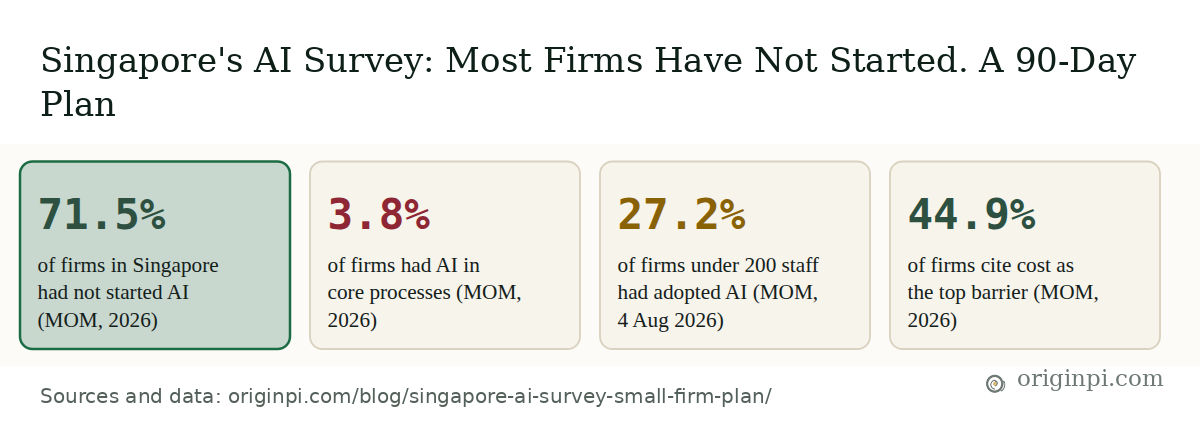
Most Singapore firms have not started with AI, and the government's own survey says so: 71.5% had not begun, and only 3.8% had built AI into core processes. The Ministry of Manpower (MOM) puts adoption at 27.2% for firms under 200 staff and 76.4% for firms above 500. This post is for owners and managers of small firms. It reads the official figures, shows what holds small firms back and ends with a 90-day first step you can start this week.
MOM published its survey report on 30 April 2026 (press release) and repeated the size figures in a parliamentary answer on 4 August 2026. Every number below comes from those documents, plus a 9 September answer on support.
Update, 28 October 2026: We re-read MOM's survey report and press release and its 4 August and 9 September written answers. No figure has changed, and MOM's 9 September answer still says it is too early to give disbursement figures for the ECI and Champions of AI schemes.
At a glance: what Singapore firms say about AI adoption
Official survey figures, MOM, 2026. Not all firms are covered: only those with 10 or more employees.
What did MOM's 2026 survey find?
MOM's survey of 2,560 private-sector workplaces found that 71.5% had not started with AI and 28.5% had. Of that 28.5%, planning (7.4%) and piloting (6.0%) make 13.4%, which is under half. Fieldwork ran from 19 January to 31 March 2026. MOM's report, "Adoption of Artificial Intelligence Among Firms", covers establishments with at least 10 employees and records a 97.4% response rate.
Interactive chart
71.5% of firms had not started, and only 3.8% had AI in core processes
Share of firms by stage of AI adoption, Singapore, 2026. The five stages add up to 100%.
Not started 71.5%, active use by employees 11.3%, planning 7.4%, piloting 6.0%, integrated within processes 3.8%.
| Stage | Share of firms (%) |
|---|---|
| Not started | 71.5 |
| Active use by employees | 11.3 |
| Planning | 7.4 |
| Piloting or testing | 6.0 |
| Integrated in processes | 3.8 |
Read the 28.5% with care. MOM counts a firm as "adopted" if it is planning AI, piloting AI, actively integrating AI within its processes, or has employees actively using AI. Take planners out and 21.1% of firms were piloting, using or integrating AI (our arithmetic: 11.3 + 6.0 + 3.8). Only 3.8% had integrated AI into core work, the step that changes how a firm runs.
Among the 28.5% that have adopted AI, the depth of use remains shallow, with only 3.8% of firms reporting that AI has been integrated into their core business processes
Ministry of Manpower, Manpower Research and Statistics Department, Adoption of Artificial Intelligence Among Firms, "AI Adoption Remains at an Early Stage", page 9, April 2026.
Among firms using AI, 70.7% reported better worker productivity and only 6.2% reduced headcount. Those are self-reports, so they show what early users noticed, not what your firm will gain.
Where does a firm your size sit?
The larger the firm, the likelier it has started. MOM's report gives 23.9% for firms with fewer than 25 employees, 29.2% for 25 to 99, 43.4% for 100 to 199, 54.8% for 200 to 500 and 76.4% for above 500. MOM's written answer of 4 August 2026 groups the three smallest bands: 27.2% for firms under 200 staff.
Interactive chart
Adoption climbs with firm size, from 23.9% to 76.4%
Share of firms that have adopted AI, by number of employees, Singapore, 2026.
Fewer than 25 staff 23.9%, 25 to 99 29.2%, 100 to 199 43.4%, 200 to 500 54.8%, above 500 76.4%.
| Employees | Adopted AI (%) |
|---|---|
| Under 25 | 23.9 |
| 25 to 99 | 29.2 |
| 100 to 199 | 43.4 |
| 200 to 500 | 54.8 |
| Above 500 | 76.4 |
MOM's explanation is that larger firms have "greater capacity to absorb upfront investment costs" and stronger reasons to automate at scale. Sector counts too: information and communications leads at 74.1%, retail trade sits at 23.4% and food and beverage at 21.9%.
The survey left out firms with fewer than 10 employees, so for a very small business these figures are the nearest official picture. Pick your headcount below.
Where does my firm sit
How does your size band compare?
One question. A guide, not an audit. Nothing you choose leaves your browser.
- If you have fewer than 10 staff, you are outside MOM's survey. The nearest figure is 23.9% for firms under 25 staff.
- If you have 10 to 24 staff, MOM puts adoption at 23.9% for your band, against 28.5% for all firms.
- If you have 25 to 99 staff, adoption is 29.2%.
- If you have 100 to 199 staff, adoption is 43.4%.
- If you have 200 to 500 staff, adoption is 54.8%.
- If you have more than 500 staff, adoption is 76.4%.
What holds small firms back?
Small firms name cost and skills first. Among firms with fewer than 200 employees, 44.7% cited high implementation costs and 42.1% a lack of skilled people. Integration with existing systems came next at 37.2%, then unclear strategy at 32.4% and resistance or low trust in AI at 30.8%. Data privacy or security worried 28.3%. Regulatory or compliance barriers came last at 13.0%.
Interactive chart
Small firms name cost and skills; large firms name integration and data
Share of firms citing each challenge in adopting AI, by firm size, 2026. Firms could pick more than one.
High implementation costs: under 200 staff 44.7%, above 500 staff 45.9%; Lack of skilled personnel: under 200 staff 42.1%, above 500 staff 53.5%; Integration with existing systems: under 200 staff 37.2%, above 500 staff 56.1%; Lack of clear strategy: under 200 staff 32.4%, above 500 staff 32.5%; Resistance or low trust in AI: under 200 staff 30.8%, above 500 staff 28.7%; Data privacy or security: under 200 staff 28.3%, above 500 staff 55.4%; Regulatory or compliance barriers: under 200 staff 13.0%, above 500 staff 28.7%.
| Challenge | Under 200 staff | Above 500 staff |
|---|---|---|
| High implementation costs | 44.7 | 45.9 |
| Lack of skilled personnel | 42.1 | 53.5 |
| Integration with existing systems | 37.2 | 56.1 |
| Lack of clear strategy | 32.4 | 32.5 |
| Resistance or low trust in AI | 30.8 | 28.7 |
| Data privacy or security | 28.3 | 55.4 |
| Regulatory or compliance barriers | 13.0 | 28.7 |
Large firms differ. Integration (56.1%) and data privacy or security (55.4%) lead for firms above 500 staff. Their problem is plumbing and exposure. A small firm's is money, know-how and what to try.
The small-firm barriers can be worked on. Two of them, lack of strategy and low trust, MOM says could be addressed through "enhanced communication strategies, and practical demonstrations of AI benefits". A named task, a written rule and a measured pilot are that, in miniature. One caution on cost: the survey asked about challenges firms "face or will face", so 44.7% records expectation as well as experience. It is not measured spend.
What do small firms do first?
Among firms that had started planning, smaller firms put training and tools first, and few had written any AI policy. Of firms under 200 staff, 46.6% had started or planned internal training and 41.1% had provided AI tools or subscriptions. Only 13.5% had developed AI governance or related policies, against 37.5% of firms above 500 staff.
Interactive chart
Small firms start with training and tools; few have written policies
Share of firms that started or planned each support step, by firm size, 2026. Base: firms planning, piloting, integrating or using AI.
Internal training and upskilling: under 200 staff 46.6%, above 500 staff 73.3%; Provision of AI tools and subscriptions: under 200 staff 41.1%, above 500 staff 63.3%; External courses or certifications: under 200 staff 26.9%, above 500 staff 40.0%; AI governance and related policies: under 200 staff 13.5%, above 500 staff 37.5%; Job redesign and progression pathways: under 200 staff 11.4%, above 500 staff 22.5%.
| Initiative | Under 200 staff | Above 500 staff |
|---|---|---|
| Internal training and upskilling | 46.6 | 73.3 |
| Provision of AI tools and subscriptions | 41.1 | 63.3 |
| External courses or certifications | 26.9 | 40.0 |
| AI governance and related policies | 13.5 | 37.5 |
| Job redesign and progression pathways | 11.4 | 22.5 |
The base is firms at least planning AI. Our plan starts with training and tools too. The policy gap is the cheapest to close: a one-page rule on what staff may paste into an AI tool costs time, not budget. It is a first step, not PDPA compliance on its own: the Personal Data Protection Commission's Advisory Guidelines on use of Personal Data in AI Recommendation and Decision Systems (issued 1 March 2024) set out how the PDPA applies when a business uses personal data in an AI system.
What does a 90-day first step look like?
One task, one owner, one measure, 90 days. The diagram shows the three phases and which barrier each one answers.
A 90-day first step: three phases and the small-firm barriers each one answers
Barrier shares are for firms under 200 staff (MOM, 2026). The plan is Origin Pi design.
The table links each small-firm barrier from MOM's survey to a step in the plan. The plan is Origin Pi's own design, not an official standard.
| Barrier (firms under 200 staff) | Share citing it | What the plan does |
|---|---|---|
| High implementation costs | 44.7% | One task, a small pilot, a stop rule on day 90 |
| Lack of skilled personnel | 42.1% | Train the two or three pilot users first |
| Integration with existing systems | 37.2% | Start with a task that needs no system change |
| Lack of clear strategy | 32.4% | One sentence: task, owner, measure, date |
| Low trust in AI | 30.8% | Human checks every output, errors are logged |
| Data privacy or security | 28.3% | A one-page rule on what data may go in |
Days 1 to 30: choose and set the rules.
- Week 1: name the task and one owner, a person and not a team. Pick work done every week that eats three or more hours, such as quote drafting, meeting notes or first replies to enquiries.
- Weeks 1 and 2: time the task for one typical week and count the errors or rework. That is your baseline.
- Week 3: write the data rule on one page. List what may go into an AI tool, what may not (customer personal data and contracts are the usual first items) and who approves exceptions.
- Week 4: choose the tool and two or three pilot users. Pick a tool that needs no change to your other systems. Write your keep rule now, for example: time down by a quarter and corrections no higher than the baseline.
If the first task is marketing, Origin Pi's marketing consultancy brand leapbuzz has a roadmap for moving a marketing team past the pilot stage. Our guides to the agent-readiness audit and what to log cover the baseline and the record.
Days 31 to 60: pilot and measure.
- Week 5: one hour of training with real samples of the task and the data rule. Training comes first because it is where small firms start.
- Weeks 6 to 8: the pilot users do the task with the tool. A person reviews every output before it reaches a customer.
- Every Friday, ten minutes: log hours taken, edits made and anything that went wrong. Pause the pilot if personal data goes in against your rule.
Days 61 to 90: decide and embed.
- Week 9: compare the pilot with your baseline, using the keep rule you wrote in week 4.
- Week 10: a 30-minute meeting with the owner and pilot users. Choose keep, change or stop. Stopping is a valid result.
- Weeks 11 and 12: if you keep it, write the task into the normal routine with an owner and a check. If you change it, run 30 more days. Embedding moves a firm toward the 3.8% that have integrated AI into core processes.
Illustrative example: a 30-person trading firm picks first replies to customer enquiries. In the baseline week, two staff spend about 6 hours on first replies and 1 in 10 needs a correction. The pilot gives the two staff an AI drafting tool and a rule that no customer data goes in beyond the enquiry text. After 30 days, the same work takes about 4 hours, and 1 in 20 needs a correction. The numbers are invented. On day 90 the owner keeps the tool and names the next task.
Tick off the plan below to see where you stand.
90-day plan builder
Tick what your plan already has
Eleven steps across three phases. Weighted by importance. A guide, not an audit. Nothing you tick leaves your browser.
- 0 to 39%: Not started. Begin with days 1 to 30: one task, one owner, a baseline and a data rule.
- 40 to 79%: Plan taking shape. Close the gaps before you widen the pilot.
- 80 to 100%: Ready to decide. You have the pieces. The day 90 decision is the one that counts.
The plan is Origin Pi design, not an official standard. The steps are our reading of the survey barriers.
On public support, MOM's written answer of 9 September 2026 says support for firms' AI capability building runs through enterprise and workforce schemes available to Singapore-based firms across all sectors. It adds: "As some of these schemes, such as ECI and Champions of AI, were only launched in 2025 or 2026, it is too early to provide meaningful disbursement figures." Check current terms on the scheme owner's page before you plan around one.
Where Origin Pi stands
MOM's numbers say small firms are stuck at the start. We read that as a control problem as much as a tooling one: who may use which tool on which data, who checks the output, and what the record shows. Origin Pi designs those control points, and they carry over if the tool later becomes an AI agent that acts rather than drafts.
This is general information, not advice. The survey is a snapshot of early 2026, and MOM's report says "continued monitoring will be important as adoption deepens".
Your first step this week: write one sentence naming the task, the owner, the measure and the date of day 90, and time the task once as it is done today.
Take the data with you
Every figure in this post's charts and at-a-glance card is in one table, with its source, source date and the date we read it. If you reuse either file, please cite this post and link back to it.