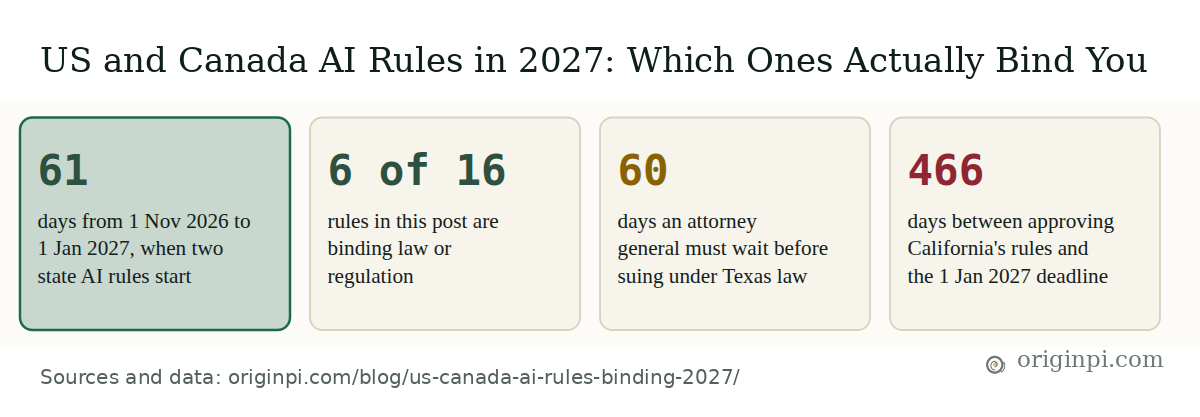
Six rules bind a company that sells AI-assisted services into the US and Canada in 2027, and ten other items are orders, drafts, consultations or voluntary guides. Two of the six apply from 1 January 2027: California's rules on automated decisions and Colorado's AI law. This is for the CEO and general counsel of a Singapore or Malaysia firm selling in North America. Not legal advice. Financial regulators: see our map.
We read every source on 28 October 2026 and checked the Canadian bills again before publishing.
At a glance: which US and Canadian AI rules bind in 2027
Counts and dates from statutes, regulations and official pages, read 28 Oct 2026.
Is there one US AI law, or fifty?
Neither. We found no single federal AI statute. Older law already covers AI, a few states have AI laws, and a federal push to override them is not law yet. The FTC made the first point in its September 2024 announcement: "there is no AI exemption from the laws on the books."
We sorted 16 instruments into four groups. Binding is a statute or regulation in force or with a start date. Federal action is an order or filing that binds no private company. Proposed is a draft, bill or consultation. Voluntary is guidance.
Interactive chart
Six of 16 instruments bind a company
Instruments by legal status, 28 October 2026.
Binding 6, federal action 3, proposed 4, voluntary 3.
| Status | Instruments |
|---|---|
| Binding | 6 |
| Federal action | 3 |
| Proposed | 4 |
| Voluntary | 3 |
The federal effort works through agencies and Congress. Executive Order 14365, signed on 11 December 2025, directs the Attorney General to set up an AI Litigation Task Force "whose sole responsibility shall be to challenge State AI laws inconsistent with the policy". A memo of 9 January 2026 created it.
The order also asks for a bill. The White House's recommendations, dated March 2026, state the aim:
Congress should preempt state AI laws that impose undue burdens to ensure a minimally burdensome national standard consistent with these recommendations, not fifty discordant ones.
The White House, A National Policy Framework for Artificial Intelligence: Legislative Recommendations, March 2026.
The same document says a national standard should not preempt state laws of general applicability, "including particular laws to protect children, prevent fraud, and protect consumers". A request is not a statute. Until Congress or a court acts, plan for the state rules that have dates.
The map below shows the layers.
Three layers of rules for one AI use, and where each stands
Green is binding. Amber is a push that is not law that overrides a state statute.
Which US rules bind, and from when?
Four US rules bind a company with the right facts: the FTC Act, Texas, California and Colorado. Two of them apply from 1 January 2027.
The FTC Act applies today. It bans deceptive practices, including AI claims. A July 2026 proposed policy statement says an AI company that alters its system's outputs to pursue undisclosed ideological goals could be deceiving consumers and breaking Section 5. Comments closed on 31 July 2026. It is a draft, a signal and not a rule.
Texas has applied since 1 January 2026. The Texas Responsible Artificial Intelligence Governance Act, HB 149, covers a person who promotes, advertises or conducts business in Texas, or whose product Texas residents use. It is narrow for private companies. It bans AI used "in a manner that intentionally aims to incite or encourage" self-harm, harm to others or crime, and AI used "with the intent to unlawfully discriminate against a protected class". "A disparate impact is not sufficient by itself to demonstrate an intent to discriminate." Only the attorney general enforces it, after a 60-day cure window.
California's automated decision rules apply from 1 January 2027. The Office of Administrative Law approved the regulations on 22 September 2025. Under section 7200, a business that uses automated decisionmaking technology (ADMT) for a significant decision must meet the deadline the rule sets, "no later than January 1, 2027". A significant decision concerns lending, housing, education, employment or compensation, or health care. The business must give a plain-language pre-use notice, and consumers can opt out or appeal and can access information about the ADMT.
Two limits matter. The rules reach only businesses the CCPA covers. The California Attorney General lists three tests: a revenue threshold, 100,000 or more California residents or households, or 50% or more of revenue from selling personal information. And the regulation defines ADMT as technology that processes personal information and uses computation "to replace human decisionmaking or substantially replace human decisionmaking" (section 7001(e)). In our reading, technology will "substantially replace human decisionmaking" when a business uses the output to make a decision without human involvement, and human involvement means a reviewer who knows how to interpret and use the output, reviews and analyses it, and has authority to make or change the decision (the confirm step).
Colorado's AI law applies to decisions made from 1 January 2027. SB 26-189, signed on 14 May 2026, covers developers and deployers that are a "person doing business in Colorado". A deployer must give notice before using a covered ADMT and, within 30 days after an adverse outcome, describe the decision and the tool's role. Consumers can ask for correction and human review. Developers owe deployers documentation. The Attorney General must adopt rules on post-decision disclosures by 1 January 2027. See our Colorado guide.
Enforcement is the open question. A Legislative Council fiscal note of 8 September 2026 says a US District Court ordered the Attorney General on 27 April 2026 "to not initiate enforcement" until rulemaking is complete and the court rules in X.AI LLC v. Weiser. The Justice Department moved to intervene on 24 April 2026. Prepare; do not wait.
Interactive chart
California gave 466 days, Texas 193 and Colorado 232
Days from approval or signing to the start of AI duties.
California ADMT rules 466 days, Colorado SB 26-189 232 days, Texas HB 149 193 days.
| Rule | Days |
|---|---|
| California ADMT | 466 |
| Colorado SB 26-189 | 232 |
| Texas HB 149 | 193 |
The next rule may give less warning.
What binds in Canada?
In Canada, privacy law does the work, because there is no AI-specific federal statute. The Artificial Intelligence and Data Act was part of Bill C-27, which LEGISinfo shows in a prior session that ran to 6 January 2025. No statute has replaced it. Two June 2026 bills are related. Bill C-36 amends PIPEDA. Bill C-34, the Safe Social Media Act, introduced on 10 June 2026, would put a Duty to Act Responsibly on AI chatbot services, says the Government of Canada. LEGISinfo shows C-36 at second reading in the House of Commons. C-34 passed second reading on 29 October 2026 and went to the House Canadian Heritage committee. Neither is law.
The Personal Information Protection and Electronic Documents Act (PIPEDA) applies to "every organization" for personal information it handles in commercial activities, including AI tools that process customer, lead or staff data. On 6 May 2026 the privacy commissioners found "a real and substantial connection to Canada" for OpenAI, and that it lacked implied consent to train and missed accuracy requirements. Assume the test can reach a Singapore firm with Canadian customers.
Ontario has an AI-specific duty in force for ordinary employers. Section 8.4 of the Employment Standards Act, 2000 requires a publicly advertised job posting to include "a statement disclosing the use of the artificial intelligence" if AI is used to "screen, assess or select applicants". It has applied since 1 January 2026.
The government's AI transparency consultation ran from 23 July to 23 September 2026 and closed without a bill. LEGISinfo's progress fields for C-36 are inconsistent (first reading 15 June 2026), so re-read the page. This post does not cover Quebec's privacy law.
All 16 instruments, with status, date and what could change
Six of the 16 instruments bind a company. First actions, then all 16 with status and date.
| Rule | First action | Date that matters |
|---|---|---|
| FTC Act | Back every public AI claim with evidence | Applies now |
| Texas HB 149 | Record the purpose of each AI system | In force since 1 Jan 2026 |
| Ontario ESA 8.4 | Add an AI statement to public job postings | In force since 1 Jan 2026 |
| PIPEDA | Record purpose and consent basis per tool | Applies now |
| California ADMT | Draft the pre-use notice and opt-out or appeal route | Comply by 1 Jan 2027 |
| Colorado SB 26-189 | Build notice and the 30-day explanation into the workflow | Decisions from 1 Jan 2027 |
Compare
US and Canadian AI instruments by status
Filter by status. Green means binding or already started, amber means conditional or future, grey means not binding.
| Instrument | Binds a company? | Date of status | Reaches |
|---|---|---|---|
| FTC Act, AI claims (US) | Yes, existing law | In force; FTC statement 25 Sep 2024 | Any business selling to US consumers |
| Texas HB 149 | Yes, narrow | In force 1 Jan 2026 | Business in Texas or product used by Texans |
| California ADMT regulations | Yes, if CCPA covers you | Comply by 1 Jan 2027 | ADMT for a significant decision |
| Colorado SB 26-189 | Yes, enforcement limited by court order | Decisions from 1 Jan 2027 | Consequential decisions in Colorado |
| Ontario ESA section 8.4 | Yes | In force 1 Jan 2026 | Public job postings using AI screening |
| PIPEDA (Canada) | Yes, existing law | Current to 30 Sep 2026 | Personal data in commercial activity |
| Executive Order 14365 | No, directs agencies | Signed 11 Dec 2025 | Federal agencies |
| DOJ AI Litigation Task Force | No, litigation unit | Memo 9 Jan 2026 | State AI laws |
| DOJ in xAI v. Weiser | No, court filing | Motion 24 Apr 2026 | Colorado's 2024 law |
| FTC policy statement on AI accuracy | No, proposed | Proposed 1 Jul 2026 | AI developers |
| White House legislative recommendations | No, request to Congress | March 2026 | Congress |
| Canada Bill C-36 | No, bill | At second reading, 28 Oct 2026 | PIPEDA organisations |
| Canada AI transparency consultation | No, consultation | Closed 23 Sep 2026 | Labelling, chatbots, agents |
| Privacy commissioners' generative AI principles | Guidance on privacy law | 7 Dec 2023 | Developers, providers, users |
| Canada voluntary code, generative AI | Voluntary | Sep 2023 | Developers and managers |
| NIST AI Risk Management Framework | Voluntary | 26 Jan 2023 | Any organisation |
Key: binding or started · conditional or later · not binding · n/a
Status as read on 28 October 2026 (Canadian bills checked again before publishing). General information, not legal advice. Other US states have narrower AI rules that are outside the scope of this post. Canada's Bill C-34 is covered in the text but not counted in the 16.
Four things can move the map: a ruling in X.AI LLC v. Weiser, a final FTC statement, Colorado rules, or a preemption bill. None had removed a state duty in the sources we checked on 28 October 2026. Re-read the official pages first.
Does it apply to my AI use?
Start with the person the AI affects, not the tool. Answer up to four questions per AI use.
Decision tree
Which rule reaches this AI use?
Up to four questions. A guide, not legal advice. Nothing you choose leaves your browser.
- No rule in this post applies directly. These rules turn on where the affected people are. Check the market you do serve.
- The FTC Act applies today (binding, existing law). Back each claim about what the AI can do. The FTC says there is no AI exemption from the laws on the books (25 Sep 2024). If the AI also helps decide a job, loan, home, school place, insurance or care, run the path again.
- Colorado SB 26-189 (binding for decisions from 1 Jan 2027). Deployers give notice before use, an explanation within 30 days of an adverse outcome, and a route to correction and human review. A court order of 27 Apr 2026 limited enforcement. Ask counsel about scope.
- Texas HB 149 (binding since 1 Jan 2026, narrow). The bans turn on intent to incite harm or to discriminate. Disparate impact alone is not enough. The attorney general enforces after a 60-day cure window.
- No AI-specific rule found here for that state. Other states have narrower AI rules outside the scope of this post. The FTC Act applies everywhere in the US.
- California ADMT rules apply (comply by 1 Jan 2027). Give a plain-language pre-use notice, an opt-out or appeal route, and access to information about the tool. Start now.
- You may fall outside the ADMT definition. The rule covers technology that uses computation "to replace human decisionmaking or substantially replace human decisionmaking", which in our reading means decisions made without human involvement. Involvement needs a reviewer who can interpret the output, analyse it and change the decision. Keep a log of that review, and ask counsel.
- Confirm CCPA coverage before 1 Jan 2027. The ADMT rules reach only businesses the CCPA covers. Check the three tests with counsel.
- PIPEDA applies (binding, existing law). Know the purpose, consent basis and accuracy controls for each AI tool, and whether a vendor trains on your data.
- Ontario ESA section 8.4 (binding since 1 Jan 2026). A public job posting must say when AI is used to screen, assess or select applicants. Exceptions are set by regulation. PIPEDA also covers applicant data.
- No AI-specific Canadian rule found for this use. Bill C-36 (at second reading), Bill C-34 (in committee since 29 Oct 2026) and the AI transparency consultation are proposals. Privacy law still applies to any personal information involved. If the AI is a chatbot, watch C-34.
Illustrative example: a Singapore firm sells a tool that ranks job applicants with little human review. One US customer hires in Colorado, one Canadian customer in Ontario. From 1 January 2027 the tool is a covered ADMT for the Colorado customer, so the firm is a developer and the customer a deployer. The Ontario posting must disclose AI screening.
Which gaps should you check by 1 January 2027?
Tick what is true today. It covers the six binding rules and a watch item. The result lists gaps to check. It is not a compliance determination.
Self-assessment
Which gaps should you check by 1 January 2027?
Tick what is true now. Heavier items count more.
- 0 to 39%: Many gaps to check. Start with the list of AI uses and the decisions they touch.
- 40 to 74%: Some gaps to check. Close the 2027 gaps first: notices, human review and records.
- 75 to 100%: Fewer gaps to check. Keep the monthly re-check going and confirm scope with counsel.
Weights are illustrative. Total 26 points. Based on the rules named in this post. Not legal advice and not a compliance determination. Nothing you enter leaves your browser.
Where Origin Pi stands
Most of this is a records problem. Origin Pi's AI governance work designs AI agents with bounded scope, named owners and logs, which gives you the list of uses and the evidence of human review these rules ask about. See what to log for AI work. Have a lawyer confirm scope.
Your first step this week: list every AI use that touches a person in the US or Canada, mark those that help decide a job, loan, housing, school, insurance or health care, and note where each person lives.
Take the data with you
Every figure in the charts and at-a-glance card is in one table, with its source and dates. If you reuse either file, please cite this post.